What Is Teleradiology? How Remote Radiology Reading Works in 2026
Your on-call radiologist is three time zones from the scanner. Teleradiology closes that gap, and in 2026 the reading workflow depends on the platform moving the images. Slow retrieval and clunky viewers are where remote reading breaks down.
This article explains how remote radiology reading works today, from DICOM capture to remote diagnosis, and what to check in a teleradiology platform. You will see how Medicai fits the workflow, compare its features, security, and pricing, and decide whether it suits your hospital, imaging center, or teleradiology team.
What Is Medicai? The Platform Behind Modern Teleradiology
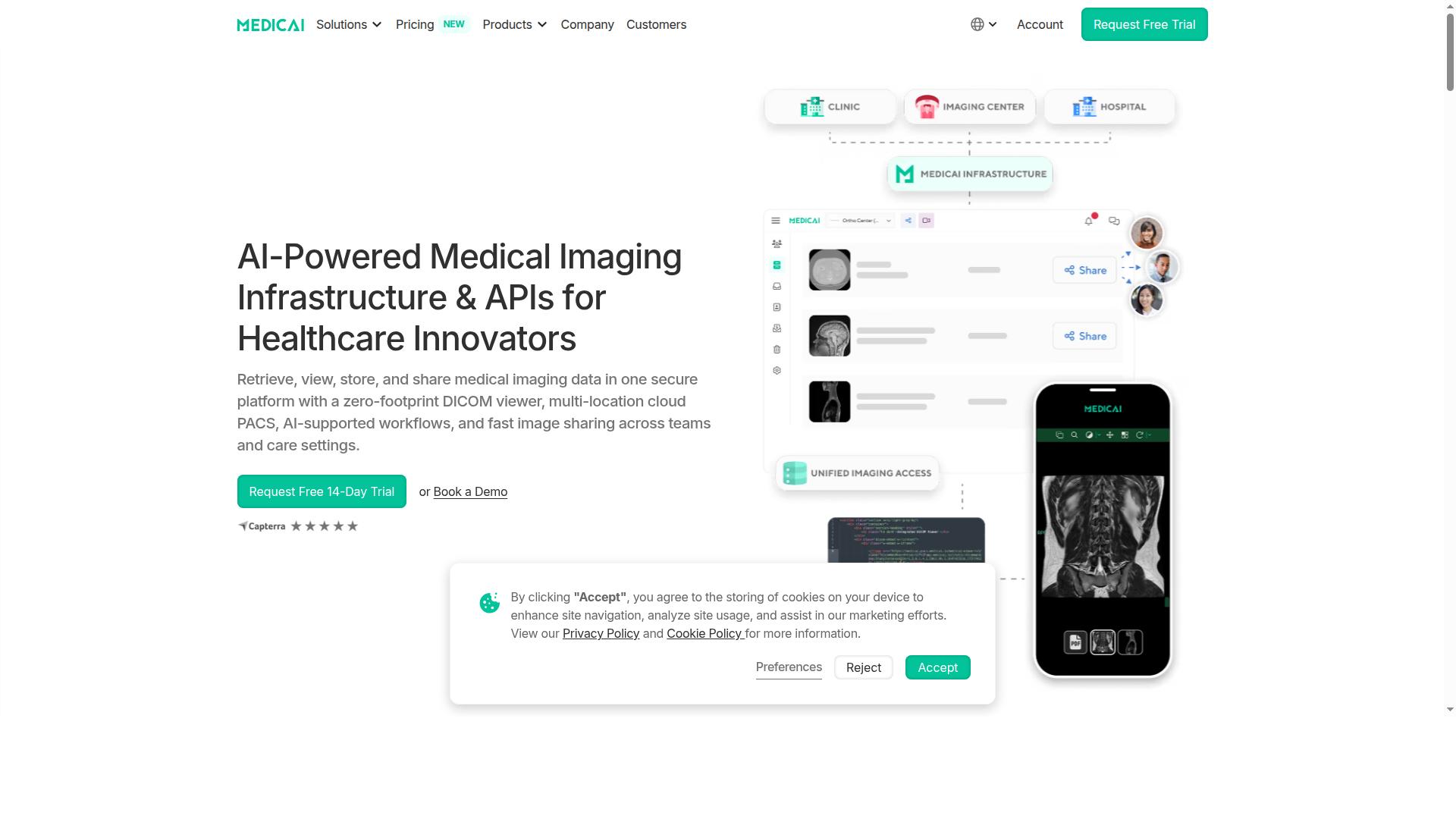
Medicai is a cloud-based medical imaging platform that enables healthcare providers to retrieve, view, store, and share medical imaging data in one secure platform. It is a VC-backed healthcare startup focused on modernizing medical imaging workflows and enabling interoperability.
At the center of the platform sits a zero-footprint DICOM viewer paired with a cloud PACS. Because the viewer runs without local installation, a teleradiologist can open studies from any connected device and read them wherever they are.
That architecture is what makes remote radiology reading practical. Images are stored in the cloud rather than on a single workstation, so access does not depend on being inside the hospital network. HIPAA and GDPR compliance and OWASP security guidelines underpin how that access is protected.
The track record is meaningful: more than 2M imaging studies uploaded, over 1M studies processed per year, and 10,000+ active doctors on the platform. For a teleradiology operation evaluating infrastructure in 2026, that is a working system, not a concept.
Who Medicai Serves: Hospitals, Imaging Centers, and Teleradiology Providers
Medicai's platform is designed for a diverse range of healthcare providers, including hospitals, imaging centers, and specialty care providers such as orthopedics, neurology, oncology, and radiology. The platform also supports cardiology, ophthalmology, ob-gyn, pulmonology, dentistry, and gastroenterology practices.
Each group uses cloud-based imaging differently, and the workflows reflect that:
- Hospitals use the platform to consolidate diagnostic imaging across departments and give on-call radiologists remote access for overnight coverage and STAT reads.
- Imaging centers store and share studies without maintaining heavy on-site infrastructure, which simplifies image transmission to referring physicians.
- Teleradiology providers route studies to remote radiologists for subspecialty interpretation and distributed reading schedules.
- Specialty practices in orthopedics, neurology, or oncology pull prior studies into their own workflow for comparison and treatment planning.
The platform also serves virtual care providers, telemedicine platforms, tumor boards, clinical trials, medical education organizations, and patients through a Patient Portal. For teleradiology services specifically, the value is straightforward: secure access to imaging data from anywhere, with a radiology workflow that does not stop at the hospital door.
With 70 clinics and hospitals on the platform today, Medicai is built for organizations that need remote reading to function as a daily operation, not an occasional fallback.
What Is Teleradiology and How Does Remote Radiology Reading Work in 2026?
Teleradiology in 2026 is defined by seamless digital workflows that allow radiologists to interpret images remotely with high accuracy and speed. It is a core branch of telemedicine in which diagnostic imaging studies are transmitted from the site where they are acquired to a radiologist working elsewhere.
The model supports overnight coverage, STAT reads, and subspecialty interpretation for facilities that cannot staff every specialty around the clock. A nighthawk service, for example, lets a small hospital route after-hours studies to a remote teleradiologist.
Three trends shape remote radiology reading in 2026. AI-assisted triage flags urgent studies for earlier review, cloud-based imaging reduces on-site hardware needs, and cross-state licensing through interstate compacts simplifies credentialing across state lines. Data security, HIPAA compliance, and GDPR obligations remain central to every deployment.
The 2026 Workflow: From DICOM Capture to Remote Diagnosis
The 2026 teleradiology workflow begins with DICOM capture at the imaging site and ends with a final report delivered securely to the referring physician. Each step is designed to keep turnaround time short without compromising accuracy.
- Image acquisition. Modalities such as CT, MRI, and ultrasound produce studies in DICOM format at the hospital or clinic.
- Transmission. Studies move over encrypted connections to a cloud PACS or the receiving provider's system.
- Storage and routing. The cloud PACS stores images and the RIS manages orders and worklists, with HL7 and FHIR handling interoperability between systems.
- Remote access. The teleradiologist opens the study in an advanced diagnostic viewer with measurement, comparison, and windowing tools.
- Interpretation and reporting. The radiologist dictates or structures a preliminary or final report, which is sent securely to the referring clinician.
- Quality assurance. Peer review and audit steps check report accuracy and consistency over time.
Bandwidth and latency matter most for large studies such as multiphase CT and MRI. Facilities typically size connections to handle peak volumes and use compression or streaming viewers to keep image loading responsive.
Security runs through every step. Encryption in transit and at rest, access controls, and audit trails support HIPAA compliance in the United States and GDPR obligations in Europe. Credentialing, privileging, and cross-state licensing checks are completed before a radiologist joins a reading panel, so reports carry proper authority for reimbursement under CPT codes and Medicare or private payer rules.
Key Features That Make Medicai Stand Out for Teleradiology
Medicai's feature set is engineered to address the specific demands of remote radiology reading in 2026. The platform combines a zero-footprint DICOM viewer, a multi-location cloud PACS, and AI-supported workflows into one cloud-based medical imaging platform.
These tools matter because remote radiology reading depends on fast access to diagnostic imaging, reliable image transmission, and a radiology workflow that keeps turnaround time predictable. Medicai delivers all three through its Imaging Infrastructure as a Service model.
More than 10,000 active doctors and 70 clinics and hospitals already work on the platform, with 2M+ imaging studies uploaded and 1M+ studies transacted or processed per year. The sections below break down what each core capability does for a teleradiologist.
Zero-Footprint DICOM Viewer, Cloud PACS, and AI-Supported Workflows
Medicai's zero-footprint DICOM viewer allows radiologists to access and interpret studies directly from a web browser without installing software. There is no local storage to manage and no workstation to configure, so a teleradiologist can begin reading as soon as access is granted.
The cloud PACS stores and organizes studies across locations, and the platform supports unlimited user accounts on every plan. Connected locations scale with the plan: Standard includes one connected location, while Enterprise covers multiple connected locations and multiple external locations.
AI-supported workflows add another layer to remote radiology reading. Medicai integrates with AI partners such as MD.ai and Rayscape.ai, and offers a Radiology AI Co-Pilot and AI-Powered Diagnostics. In practice, AI-assisted triage helps teams prioritize urgent studies so STAT reads move ahead of routine ones.
Supporting capabilities round out the workflow:
- Structured Reporting for Radiology and Patient Case Management
- Medical Image Exchange and a Vendor Neutral Archive
- Medicai Imaging API, with 50M+ yearly API transactions
- Mobile Imaging App and Doctor Imaging Portal
- FDA/CEE Cleared Viewers, backed by a Microsoft Azure partnership
Medicai reports that its platform reduces diagnosis time by 65%. For overnight coverage and nighthawk-style services, that speed compounds across every shift.
Security and Compliance: HIPAA, GDPR, and OWASP Guidelines
Medicai prioritizes data security with HIPAA and GDPR compliance, and adheres to OWASP guidelines to protect sensitive medical imaging data. These are not optional extras in teleradiology, where patient images and final reports cross state lines and national borders daily.
Data security rests on a few core controls. Encryption protects data in transit and at rest, so image transmission stays protected between the sending site and the reading radiologist. Access controls and audit logs limit who can view a study and record who did.
OWASP guidelines address web application security, the layer most exposed when a radiologist opens a DICOM viewer in a browser. Following them helps defend against common web vulnerabilities that could otherwise put cloud-based imaging at risk.
Compliance carries real operational weight for teleradiology teams:
- HIPAA compliance supports U.S. payer and Medicare workflows
- GDPR compliance matters for cross-border reading in Europe
- Audit logs support quality assurance and peer review
For hospitals evaluating a remote reading partner, these safeguards are part of credentialing and privileging conversations. Medicai's compliance posture gives imaging teams a documented foundation to build on.
Pricing and Plans
Medicai offers transparent monthly pricing plans designed to accommodate practices of varying sizes and imaging volumes. The structure is simple: two published tiers, a custom enterprise option, and a free trial so teams can evaluate the platform before committing.
For teleradiology, predictable costs matter. Remote radiology reading depends on steady image transmission, storage, and access for distributed radiologists, so a clear monthly fee makes budgeting for diagnostic imaging workflows far easier than per-seat or hidden usage charges.
| Plan | Monthly Price | Yearly Price (15% savings) | Cloud Storage | User Accounts | Connected Locations |
|---|---|---|---|---|---|
| Starter | $249/month | $209/month paid yearly | 500 GB | Unlimited | None |
| Standard | $749/month | $639/month paid yearly | 2 TB | Unlimited | One |
| Enterprise | Custom pricing | Custom pricing | Custom | Unlimited | Multiple, plus multiple external locations |
The Starter plan suits small practices, single reading groups, or teams that mainly need cloud storage and secure access to studies without connecting a physical imaging site. It includes 500 GB of cloud storage and unlimited user accounts, so a growing roster of radiologists can log in without per-seat fees.
The Standard plan fits organizations that need to link an imaging location into the platform. With 2 TB of storage, unlimited users, and one connected location, it covers typical clinic or hospital department needs for cloud-based imaging and remote access.
Larger enterprises can request a custom plan with custom storage and multiple connected locations, including multiple external locations. Per-study pricing is also available for enterprise customers, which can suit high-volume operations with uneven demand.
Two cost details are worth planning for. A DICOM Gateway setup is a one-time $1,000 fee per location, which covers connecting a site to the platform. Billing is monthly or yearly, and choosing yearly billing saves 15% on either published tier.
A free 14-day trial of Starter plan features is included, and no credit card is required. That gives a radiology team room to test image transmission and workflow fit before selecting a plan. Refunds are not available for partial periods, so aligning the billing cycle with your rollout timeline is sensible.
All plans sit on infrastructure that is HIPAA and GDPR compliant and follows OWASP security guidelines, which matters when patient studies move between locations and remote readers.
Trust Signals: Track Record, Case Studies, and Partnerships
Medicai's credibility in teleradiology is backed by a strong track record, successful case studies, and strategic partnerships. The platform processes 1M+ studies per year and holds 1.7M+ studies in storage, with 300k+ DICOM visualizations in the last year and 50M+ yearly API transactions.
Those volumes sit alongside partnerships that span imaging AI, automation, and cloud infrastructure, including MD.ai, Tquila Automation, FlexView, OHIF, MedDream, Rayscape.ai, Meditice, Microsoft Azure, Hetzner, Amazon AWS, Boehringer Ingelheim, New Relic, Atlassian, Intercom, Ahrefs, and PostHog.
Proven Results: Neuroaxis and YTS-Dental View Case Studies
Two case studies illustrate Medicai's impact: Neuroaxis improved turnaround times for STAT reads, and YTS-Dental View streamlined dental imaging workflows. Both show how cloud-based imaging changes day-to-day remote radiology reading.
Neuroaxis, a neurology and neuro-oncology practice, used the platform to support faster preliminary reports and overnight coverage. According to the published case study, the practice reported 90% less time spent with non-relevant cases, 70% less face-to-face check-ups, and 1,300+ cases precisely diagnosed.
For YTS-Dental View, the zero-footprint DICOM viewer and cloud PACS made remote dental imaging interpretation practical across a distributed network. The case study reports 90% less time to access patient studies and integration of 10 locations across Romania.
These results matter for teleradiology because turnaround time and access speed drive the whole radiology workflow. Faster access to diagnostic imaging supports preliminary reports, overnight coverage, and quality assurance, while cloud-based image transmission reduces dependence on local infrastructure and bandwidth constraints.
Both organizations also speak to the experience directly. Dragos Tudorache, CEO at Neuroaxis, and Laur Alexandru Iacob, Clinical Manager at YTS-Dental View, provide testimonials on the platform, alongside Dr. Horia Vulpe and Claudia Toma MD PhD. Together with the founding team's recognition, including Forbes "30 under 30 Deloitte Technology Fast 50 CE, and a 2022 Frost and Sullivan Enabling Technology Leadership Award, the record points to a legitimate, established imaging platform rather than a newcomer.
Who Should Use Medicai for Remote Radiology Reading
Medicai is ideal for healthcare organizations that require secure, scalable, and efficient remote radiology reading solutions. The platform serves 70 clinics and hospitals and more than 10,000 active doctors, processing over 1 million studies each year. That track record makes it a practical fit for several distinct types of imaging operations.
Each organization type uses remote radiology reading differently. The right fit depends on whether you need around-the-clock coverage, access to subspecialty interpretation, or the ability to scale reading capacity across multiple sites.
Hospitals with in-house radiology departments. Hospitals face unpredictable imaging demand, and overnight or weekend gaps in coverage are common. A cloud-based imaging platform lets an in-house team extend its reach, share studies with on-call radiologists, and keep diagnostic imaging moving without building out every shift locally. Medicai reports that it reduces diagnosis time by 65%, a meaningful gain for emergency departments that depend on fast turnaround time.
Imaging centers. Independent imaging centers often want to offer subspecialty interpretation in areas like neurology, oncology, or cardiology without hiring full-time specialists for each modality. Remote radiology reading opens access to a wider pool of readers. With 2 million or more imaging studies uploaded and 1.7 million or more in storage, the platform is built to handle steady volume across a growing list of specialties.
Teleradiology providers. Teleradiology services need infrastructure that scales as their client roster grows. Medicai supports this through 50 million or more yearly API transactions and per-study pricing for enterprise customers, which suits providers billing by read volume. A nighthawk service or overnight coverage team can route studies, manage STAT reads, and keep preliminary reports flowing without maintaining its own server stack.
Specialty practices. Orthopedics, neurology, oncology, cardiology, ophthalmology, ob-gyn, pulmonology, dentistry, and gastroenterology groups all generate diagnostic imaging that benefits from expert review. These practices can send studies to a remote radiologist for subspecialty interpretation while keeping the patient relationship in-house. Tumor boards and clinical trial teams also use the platform to review DICOM studies collaboratively.
Compliance and technical compatibility. Any organization handling patient imaging must meet strict data security standards. Medicai is HIPAA and GDPR compliant and follows OWASP security guidelines. For interoperability, the platform works with DICOM imaging and supports a DICOM Gateway for connecting locations, which matters for organizations running existing PACS and RIS environments.
Pricing scales with organizational size. The Starter plan runs $249 per month with 500 GB of cloud storage, Standard is $749 per month with 2 TB and one connected location, and Enterprise offers custom storage and multiple connected locations. Yearly billing saves 15%, and a free 14-day trial requires no credit card. A DICOM Gateway setup costs $1,000 one-time per location.
The short answer: any healthcare organization that reads diagnostic imaging at volume and needs secure, compliant, cloud-based access should consider Medicai. Hospitals, imaging centers, teleradiology services, and specialty practices each gain a scalable path to faster, well-supported remote radiology reading in 2026.
Final Verdict: Is Medicai Worth It for Teleradiology in 2026?
For organizations seeking a reliable, secure, and feature-rich teleradiology platform, Medicai presents a compelling option in 2026. The platform combines the practical tools remote radiology reading depends on with the security safeguards that HIPAA compliance and GDPR obligations demand. It is a legitimate, established product with a track record that readers can verify against its published numbers.
The core strengths sit in three areas: a complete feature set, transparent pricing, and a proven operational history. Together they address the main concerns any imaging team weighs before committing to cloud-based imaging software.
Feature set: Medicai covers the essentials of a modern radiology workflow, including a zero-footprint viewer, cloud PACS, and AI integration. The zero-footprint viewer matters because it lets a teleradiologist open DICOM studies without local installs, which simplifies access across sites and shifts. Cloud PACS supports diagnostic imaging storage and retrieval, and AI integration fits the growing role of AI-assisted triage in remote radiology reading.
Security: The platform is HIPAA and GDPR compliant and follows OWASP security guidelines. For teams handling sensitive patient images, these are the baseline assurances that data security and encryption discussions hinge on. Compliance with both frameworks also helps organizations operating across US and European jurisdictions.
Pricing: Plans are published and straightforward. Monthly billing runs $249 for Starter (500 GB Cloud Storage, Unlimited User Accounts, no connected locations) and $749 for Standard (2 TB Cloud Storage, Unlimited User Accounts, one connected location). Enterprise is custom priced with multiple connected and external locations. Yearly billing saves 15%, at $209/month for Starter and $639/month for Standard. A DICOM Gateway Setup costs $1,000 one-time per location. A free 14-day trial of Starter plan features is included, and no credit card is required.
Track record: The platform reports 1M+ studies transacted or processed per year, 2M+ imaging studies uploaded, and 1.7M+ studies in storage. It also cites 300k+ DICOM study visualizations in the last year, 50M+ yearly API transactions, 70 clinics and hospitals, and 10,000+ active doctors. Medicai reports reducing diagnosis time by 65%.
No platform fits every scenario, and readers should weigh a few practical limits. The Starter plan includes no connected locations, so a single-site practice that needs gateway connectivity will likely move to Standard or above. Setup also carries the one-time $1,000 DICOM Gateway fee per location.
Refunds are not available for partial periods, so teams should use the free 14-day trial to confirm fit before committing to a billing cycle. Organizations that need per-study pricing should note it is available for enterprise customers rather than on the standard tiers.
Medicai suits several clear use cases in 2026:
- Multi-site imaging groups needing cloud PACS, a zero-footprint viewer, and connected locations under one platform.
- Hospitals and clinics that require HIPAA and GDPR compliance with OWASP-aligned security practices.
- Teleradiology operations handling high DICOM volumes and looking for AI integration and API capacity.
- Growing practices that want transparent monthly or yearly pricing with unlimited user accounts.
For a small single-site practice with light volume, the entry tiers may be more than needed. For most organizations running remote radiology reading at scale, the combination of features, security, and published pricing makes Medicai a strong choice.
On balance, the answer is yes. Medicai is worth it for teleradiology in 2026 for teams that value a complete feature set, verifiable security compliance, clear pricing, and a platform already used by 70 clinics and hospitals and 10,000+ active doctors. The absence of a permanent free tier is offset by a no-card 14-day trial, and the partial-period refund policy is a reasonable trade for published, predictable rates.
To discuss fit, pricing, or a trial, contact Medicai directly:
- Medicai USA: 7901 4th St N, STE 300, St. Petersburg, FL, 33702. Phone: +1 (832) 220 1035.
- Medicai Romania: 53-55 N Filipescu, 5th Floor, Sector 2, Bucharest, 020961. Phone: +40 316 305 875.
- Email: sales@medicai.org.
Frequently Asked Questions
What is teleradiology, and how does remote radiology reading actually work?
Teleradiology is the practice of radiologists interpreting medical images-X-rays, CTs, MRIs, ultrasounds-remotely, rather than being physically present where the scan was performed. Images are transmitted securely to a cloud platform where a radiologist can view, analyze, and report on them from any location. Medicai supports this workflow end-to-end, from image upload and DICOM transfer to viewing, structured reporting, and sharing results back to the care team.
How do images get from our scanners into a teleradiology platform?
Most imaging facilities connect their modalities through a DICOM Gateway, which automatically routes studies to the cloud, while smaller sites can use a manual Medical Imaging Uploader. Medicai offers both options: a DICOM Gateway setup is a one-time $1,000 per location, and the uploader is part of the platform. Once images are in the cloud, they're stored in a Cloud PACS and accessible to authorized readers through a zero-footprint DICOM viewer-no local software installation required.
Is teleradiology secure and compliant enough for patient data?
Yes-security and compliance are foundational to any legitimate teleradiology workflow. Medicai is HIPAA and GDPR compliant and follows OWASP security guidelines, and it offers FDA/CEE-cleared viewers, with infrastructure hosted in partnership with Microsoft Azure. Patient images and reports are exchanged through the platform's Medical Image Exchange and portals rather than insecure channels like email attachments.
Can teleradiology work for a multi-location practice or a hospital network?
Yes, and this is where cloud-based teleradiology tends to deliver the most value. Medicai's plans scale with your footprint: the Standard plan ($749/month, or $639/month billed yearly) includes one connected location, while Enterprise custom pricing supports multiple connected and external locations with custom storage. This lets organizations centralize reading across sites while keeping each location's studies organized and accessible.
How quickly can we get started, and what does it cost?
You can evaluate the platform through a free 14-day trial of Starter plan features, with no credit card required. Paid plans start at $249/month for Starter (500 GB storage, unlimited user accounts) or $209/month billed yearly, and $749/month for Standard (2 TB storage, one connected location) or $639/month billed yearly; Enterprise pricing is custom and includes per-study pricing options. Note that refunds aren't available for partial periods, and DICOM Gateway setup is billed separately at $1,000 per location.
Does teleradiology with Medicai include AI and reporting tools, or just image viewing?
It's more than viewing-Medicai bundles the tools remote readers need into one platform. That includes Structured Reporting for Radiology, a Radiology AI Co-Pilot and AI-Powered Diagnostics, a Doctor Imaging Portal for referring physicians, and a Patient Imaging Portal for sharing results with patients. Tumor Boards support and a Mobile Imaging App round out the workflow, so reads, reports, and collaboration happen in the same environment.