Best Team Assessments for Team Building: DISC, MBTI, EQ and The Five Behaviors Compared
You have four team assessments to choose from and a budget meeting on Friday. Pick wrong and the workshop becomes a personality quiz people forget by Monday. Pick right and your team actually changes how it talks to each other.
This article compares DISC, MBTI, EQ, and The Five Behaviors side by side, explains what each one measures, and shows how OptimizeTeamwork runs them in workshops. By the end you will know which assessment fits your team's problem and whether the investment is worth it.
What Is OptimizeTeamwork? The Consultancy Behind These Team Assessments
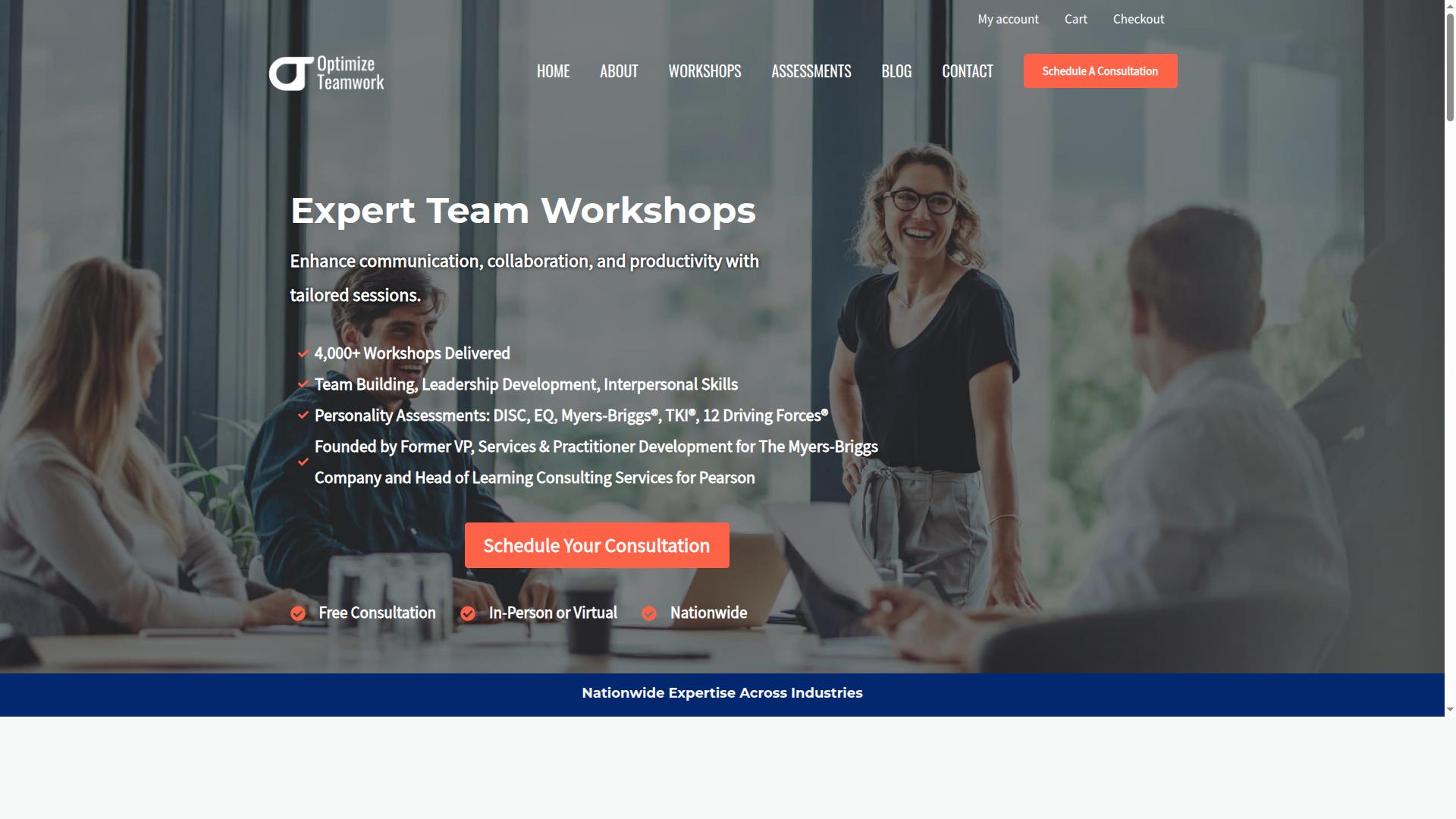
OptimizeTeamwork is a professional development and team training consultancy founded by Dr. Rachel Cubas-Wilkinson, specializing in expert team workshops that enhance communication, collaboration, and leadership. The firm designs tailored sessions that help teams work better together, and it brings a personality-informed approach to nearly every engagement.
First, a quick clarification. OptimizeTeamwork is not affiliated with Teamwork.com, the project management software company. The similar names cause occasional confusion, but the two organizations operate in entirely different spaces.
What sets the consultancy apart is its use of established team assessment tools within training. Workshops draw on instruments such as DiSC, MBTI, EQ, and TKI, and they are available with or without a personality assessment depending on what a team needs.
Delivery is nationwide, either in person or virtually, so geography rarely limits participation. The track record is substantial: more than 4,000 workshops delivered and over 30,000 leaders trained.
That experience matters for this comparison. The assessments covered in this article are the same ones OptimizeTeamwork uses in practice, which makes the firm a useful reference point as you weigh DISC, MBTI, EQ, and The Five Behaviors for your own team building efforts.
Which Team Assessment Is Best for Team Building? The Short Answer
There is no single "best" team assessment; the right choice depends on your team's goals, such as improving communication, deepening self-awareness, or building cohesion. Each of the four tools covered here answers a different question about how a team works together.
Use the guide below to match the assessment to your primary objective, then confirm the fit before committing to a rollout.
- DISC assessment: choose this when the goal is communication and behavioral styles, including how teammates adapt under pressure.
- MBTI (Myers-Briggs Type Indicator): choose this for exploring personality preferences, such as extroversion and introversion, and how those preferences shape team dynamics.
- EQ (emotional intelligence): choose this to build self-awareness, empathy, and relationship management across the group.
- The Five Behaviors: choose this for structured team building that develops trust, conflict, commitment, accountability, and results, drawing on Patrick Lencioni's work.
Many organizations combine assessments rather than picking one. A behavioral tool paired with an emotional intelligence measure, for example, can address both communication habits and the self-regulation behind them. Start with the outcome you want, then select the psychometric tool that measures it.
DISC, MBTI, EQ and The Five Behaviors Compared: How the Four Assessments Differ
These four assessments differ in what they measure, how they are administered, and the outcomes they target, so understanding their distinct approaches helps you select the right tool for your team.
Each instrument approaches team building from a different angle. DISC focuses on observable behavior, MBTI on cognitive preferences, EQ on emotional competencies, and The Five Behaviors on team cohesion.
None of these team assessment tools is universally superior. The right choice depends on whether your priority is sharper communication, deeper self-awareness, stronger emotional skills, or a more cohesive group.
The sections below examine each approach in detail so you can match the tool to your team development goals.
DISC: Behavioral Styles and Communication
The DISC assessment measures observable behavior across four dimensions, Dominance, Influence, Steadiness, and Conscientiousness, to help team members understand and adapt their communication styles.
Each style tends to show up in recognizable ways at work:
- Dominance: direct, results-focused communicators who prefer fast decisions and clear authority.
- Influence: enthusiastic, persuasive team members who thrive on collaboration and recognition.
- Steadiness: patient, supportive colleagues who value consistency and dislike abrupt change.
- Conscientiousness: analytical, detail-oriented workers who prefer accuracy and structure over speed.
In team building, DISC is typically used to improve communication, reduce friction, and increase collaboration. When colleagues recognize that a terse email reflects a Dominance style rather than hostility, minor conflicts often dissolve before they escalate.
Everything DiSC is a popular application of this framework, packaging the behavioral assessment into workplace-focused profiles and facilitated sessions. Many organizations use it as an entry point because the results are practical and easy to apply.
A useful exercise is to have each team member state how they prefer to receive feedback and how they handle pressure. This simple step turns a behavioral assessment into everyday working agreements.
MBTI: Personality Preferences and Team Dynamics
The Myers-Briggs Type Indicator (MBTI) identifies personality preferences across four dichotomies, Extraversion/Introversion, Sensing/Intuition, Thinking/Feeling, and Judging/Perceiving, to illuminate how team members process information and make decisions.
Each dichotomy shapes team dynamics in practical ways:
- Extroversion and introversion influence how people recharge and contribute in meetings, from thinking aloud to reflecting before speaking.
- Sensing and intuition affect whether someone focuses on concrete details or big-picture patterns.
- Thinking and feeling shape how decisions are weighed, through logic and consistency or through impact on people.
- Judging and perceiving describe preferences for planning ahead versus staying flexible.
These differences often explain recurring friction. A Judging planner may grow frustrated with a Perceiving colleague who adapts at the last minute, while the reverse frustration flows just as easily.
MBTI fosters self-awareness and empathy by showing that these preferences are legitimate rather than flaws. Teams often report more patience once they understand a teammate's natural approach.
It is important to note that the MBTI is an indicator of preference, not a measure of ability. No type is better than another, and results should never be used for hiring or performance judgments.
EQ: Emotional Intelligence and Team Effectiveness
Emotional intelligence (EQ) is the ability to recognize, understand, and manage one's own emotions and those of others, which directly impacts team effectiveness and workplace relationships.
Most models break EQ into core components:
- Self-awareness: recognizing your own emotions and how they affect your behavior.
- Self-regulation: managing impulses and staying composed under pressure.
- Motivation: sustaining drive toward goals beyond external rewards.
- Empathy: sensing and understanding the feelings of colleagues.
- Social awareness and relationship management: reading group dynamics and building healthy connections.
Higher EQ contributes to better communication, smoother conflict resolution, and stronger collaboration. A team member who notices tension early and addresses it calmly prevents small issues from becoming entrenched disputes.
Unlike personality-based tools, EQ can be developed through training and coaching. Workshops, feedback conversations, and deliberate practice all help people strengthen emotional skills over time.
For teams facing high stress or frequent interpersonal friction, an EQ-focused team assessment can be a practical starting point. It shifts attention from fixed traits to skills that can genuinely improve with effort.
The Five Behaviors: Building a Cohesive Team
The Five Behaviors model, based on Patrick Lencioni's Five Dysfunctions of a Team, builds team cohesion through a sequential framework: trust, conflict, commitment, accountability, and results. As a team assessment for team building, it differs from personality tests because it measures how a group works together rather than how individuals prefer to work.
The sequence matters. Each behavior depends on the one before it, so a team that skips ahead tends to stall.
- Trust: members feel safe being vulnerable about mistakes, gaps, and needs.
- Conflict: with trust in place, teams can debate ideas openly instead of avoiding friction.
- Commitment: healthy debate leads to clear decisions that everyone backs, even those who disagreed.
- Accountability: committed peers hold each other to agreed standards, not just the leader.
- Results: the team prioritizes collective outcomes over individual recognition.
In practice, a team might open a workshop by sharing a personal working-style weakness to build vulnerability-based trust. Later, members practice surfacing disagreement about a real decision before committing to it.
The Five Behaviors model is often used in team-building workshops because its sequence gives facilitators a clear order of work. Teams can also use it to diagnose exactly where collaboration breaks down.
How OptimizeTeamwork Delivers These Assessments in Workshops
OptimizeTeamwork delivers assessments through customized workshops available in-person or virtually, typically lasting 2-3 hours for virtual sessions and 3-6 hours for in-person sessions, with leadership development workshops ranging from 2-6 hours.
Participants complete their chosen team assessment beforehand, and a consultant trained and/or certified in the instrument then guides the group through the results, helping each person build self-awareness before connecting those insights to live team dynamics.
This structure matters because a personality test only creates value when people understand what it means for how they work together. Reading a report alone rarely changes behavior. Discussing it with colleagues, in a facilitated setting, is where team development actually begins.
Workshops are fully customizable and can combine multiple assessments in one engagement. A team might pair a DISC assessment with an EQ workshop, or explore Myers-Briggs Type Indicator results alongside The Five Behaviors framework. Delivery is available nationwide.
Popular options include the DISC Team Workshop ("Wired for Workplace Success: Using Behavioral Styles with DiSC®"), the MBTI-based Team Building Workshop ("Wired Differently: Understanding Personality Through Myers-Briggs®"), and the Emotional Intelligence Workshop ("The EQ Advantage"). Each one turns a psychometric tool into a shared language for communication styles and collaboration.
Pricing: Assessment Products and Custom Workshops
OptimizeTeamwork's pricing is custom for workshops based on scope, while assessment products in their shop have set prices, such as $899.00 for Emotional Intelligence Training featuring a personalized Emotional Quotient assessment and 1:1 coaching.
That flagship offering sits at the top of the shop because it pairs a psychometric tool with individual guidance. Buyers comparing EQ options should note the coaching component, which goes beyond a standalone report.
The Everything DiSC line carries lower, transparent prices, with several titles currently discounted:
| Assessment Product | Price (USD) | Previous Price |
|---|---|---|
| Everything DiSC® Workplace® | $115.00 | $129.99 |
| Everything DiSC® Agile EQ™ | $150.00 | $174.99 |
| Everything DiSC® Productive Conflict | $150.00 | $175.00 |
| Everything DiSC® Sales | $150.00 | $177.00 |
| Everything DiSC® Management | $185.00 | $210.00 |
| Everything DiSC® Work of Leaders | $185.00 | $199.00 |
Workshop pricing is not listed because it depends on duration, the number of participants, and which assessments are used. Teams weighing a DISC assessment rollout against an MBTI or Five Behaviors session can request a free 15-minute consultation to scope the work before committing.
Trust Signals: Track Record, Credentials and Testimonials
OptimizeTeamwork has delivered over 4,000 workshops and trained more than 30,000 leaders, backed by founder Dr. Rachel Cubas-Wilkinson's experience as a former VP at The Myers-Briggs Company and Head of Learning Consulting at Pearson. That track record matters when choosing a team assessment partner, because facilitation skill shapes whether a personality test or behavioral assessment actually improves team dynamics.
OptimizeTeamwork is an Authorized Partner for Everything DiSC and an authorized partner for The Five Behaviors of a Cohesive Team, and a certified Everything DiSC partner and facilitator. These credentials mean the team assessments are delivered by consultants trained and/or certified in the instruments themselves, not a generalist running a DISC assessment from a script.
The consultancy brings over three decades of combined consulting, facilitation, and learning design experience. Workshops are custom built around client goals rather than off-the-shelf modules, which supports team development work tied to trust, conflict, commitment, accountability, and results.
Client feedback reflects that focus. Sarah, Director of Clinical Pharmacology Support, reported improved trust, morale, and engagement after working with the team. For buyers weighing a psychometric tool, that combination of verified credentials and client feedback is a strong signal of team effectiveness.
Who Should Use OptimizeTeamwork for Team Assessment Training
OptimizeTeamwork's services are designed for HR and senior leaders in organizations ranging from Fortune 1,000/500/100 corporations to small and mid-size businesses, government agencies, and educational institutions. The consultancy focuses on the people who shape how a team actually works: the ones who set communication norms, coach managers, and own leadership development.
That includes HR professionals selecting a team assessment for the wider organization, team leaders working through DISC assessment or Everything DiSC results with their own groups, and executives who want a behavioral assessment tied to real leadership outcomes rather than a one-off personality test. Each group uses the results differently, so the training is framed around the decisions they actually make.
The consultancy works with organizations nationwide across sectors including Financial Services and FinTech, Technology and IT Services, Healthcare and Life Sciences, Manufacturing, Sales, Marketing and PR, Hospitality, Real Estate and Construction, Retail, Aviation, Education, Agriculture, and Government. A hospital unit wrestling with shift handoffs and a sales organization rebuilding trust after a reorg rarely need the same workshop design.
That is why workshops are customizable to meet specific organizational needs. Whether the goal is team cohesion through The Five Behaviors, stronger empathy and relationship management through an EQ framework, or clearer communication styles through MBTI or DISC, the content is shaped around the team's context instead of delivered as a fixed script.
For organizations comparing psychometric tools, this matters. A team assessment only improves team dynamics when it is interpreted well and connected to daily behavior, and that is the work OptimizeTeamwork is built to support.
Final Verdict: Are OptimizeTeamwork's Assessment Workshops Worth It?
OptimizeTeamwork offers a compelling option for organizations seeking expert-led, personality-informed team assessment workshops, backed by a strong track record and credentialed consultants. The consultancy brings DISC, MBTI, EQ and The Five Behaviors into one coherent team development offer, so a single workshop can address communication styles, self-awareness and Lencioni's trust-to-results framework together.
What stands out most is the customized workshop design. Rather than running a generic session, the team shapes the agenda around your group's dynamics and goals. Positive testimonials reinforce that experience.
On cost, the picture is straightforward. Workshop pricing is custom and quoted per engagement, while the assessment products themselves carry set prices. That structure suits teams that want a tailored program and a clear entry point for standalone tools.
For teams serious about development, the verdict is yes. Start with a conversation by phone at (561) 677-8806, or reach out through the contact form on the Contact page to discuss your team's needs.
Frequently Asked Questions
What's the difference between DISC, MBTI, EQ, and The Five Behaviors assessments?
Each assessment measures something different: DISC focuses on observable behavioral styles, MBTI® looks at personality type and cognitive preferences, EQ (emotional intelligence) assesses how people recognize and manage emotions, and The Five Behaviors® targets team dynamics like trust and accountability. The right choice depends on whether your goal is individual self-awareness, communication, emotional skills, or team cohesion. OptimizeTeamwork's consultants are trained and/or certified across all of these so they can help you match the tool to your team's needs.
Which assessment is best for our team-building workshop?
There's no single "best" assessment-it depends on your objectives, team size, and desired outcomes. A team struggling with interpersonal friction may benefit from DISC or The Five Behaviors, while a leadership group focused on self-management might gain more from EQ or MBTI®. OptimizeTeamwork offers customizable workshops in-person or virtual and can recommend the right assessment based on your goals.
Can OptimizeTeamwork deliver these workshops virtually, and how long do they take?
Yes-OptimizeTeamwork delivers workshops nationwide, both in-person and virtually. Virtual sessions typically run 2-3 hours, while in-person workshops generally run 3-6 hours; leadership development sessions range from 2-6 hours. All workshops are customizable to fit your team's scope and schedule.
How much do team assessment workshops cost?
Workshop pricing is custom based on scope, so the best way to get an accurate quote is to contact OptimizeTeamwork directly. Individual assessment products are available in the assessment shop-for example, Everything DiSC® Agile EQ™ is listed at $150.00, and Emotional Intelligence Training featuring a personalized Emotional Quotient assessment with 1:1 coaching is $899.00.
What credentials does OptimizeTeamwork bring to assessment-based training?
OptimizeTeamwork was founded by Dr. Rachel Cubas-Wilkinson, a former VP, Services & Practitioner Development for The Myers-Briggs Company and Head of Learning Consulting Services for Pearson. The consultancy is an Authorized Partner for Everything DiSC® and has delivered 4,000+ workshops and trained 30,000+ leaders. Its nationwide consultant team is trained and/or certified in DISC, Everything DiSC®, EQ, Myers-Briggs®/MBTI®, 12 Driving Forces®, and The Five Behaviors®.
Is OptimizeTeamwork affiliated with Teamwork.com?
No-OptimizeTeamwork (optimizeteamwork.com) is a professional development and team training consultancy, not the project management software company Teamwork.com. The site explicitly states it is not affiliated with Teamwork.com. To reach OptimizeTeamwork, call (561) 677-8806 or use the contact form on the website.