7 Best Companies to Hire an Ecommerce Virtual Assistant in 2026
Your store is growing faster than your team can handle. Orders pile up, customer emails sit unanswered, and product listings go stale while you focus on the next campaign. That is usually the moment owners start comparing ecommerce virtual assistant companies, and the differences between them matter more than the sales pages suggest.
This article breaks down what to check first: ecommerce platform experience, pricing models, vetting, and retention rates. Then it ranks the 7 best companies for 2026, starting with Aristo Sourcing as the top overall pick, so you can match a provider to your store and budget.
What to Look For in an Ecommerce Virtual Assistant Company
Selecting the right ecommerce virtual assistant company requires a clear understanding of the specific skills and operational factors that drive online store success. A general-purpose VA rarely fits an online store, because the work demands platform fluency and familiarity with fast-moving order and inventory workflows.
This section breaks the evaluation into two areas. The first covers platform expertise and ecommerce-specific skills, the tasks a qualified assistant should already know how to handle. The second covers business considerations, including pricing models, vetting depth, and retention rates that signal whether a provider delivers lasting value.
Ecommerce-Specific Skills and Platform Experience
When hiring an ecommerce virtual assistant, prioritize candidates with hands-on experience in the platforms and tools your business uses daily. A Shopify virtual assistant, for example, should navigate product uploads and theme settings without training, while an Amazon FBA VA needs working knowledge of Seller Central, FBA shipments, and listing compliance.
Platform familiarity matters because each marketplace has its own rules, dashboards, and quirks. Ask which systems a candidate has used and for how long. Certifications help, but proven experience usually tells you more.
- Shopify and WooCommerce: product listing services, collection setup, app configuration, theme edits
- Amazon and Walmart marketplace: listing optimization, FBA prep, buy box monitoring, case logs
- eBay store support and Etsy shop help: renewals, variations, listing SEO, review responses
- TikTok Shop: product catalogs, live selling support, affiliate coordination
Beyond the platform layer, a capable assistant handles recurring operational work. That includes order processing, inventory management, customer service outsourcing across email support and live chat support, returns handling, refund processing, and dropshipping assistance with supplier follow-ups.
Many businesses also lean on their VA for growth tasks: product research, competitor analysis, keyword research, SEO for ecommerce listings, social media management, and content creation. A single assistant may cover several of these, but be realistic about scope.
To test skills during interviews, ask candidates to walk through a real scenario. For example: "A customer wants a refund on a damaged item that shipped late. Show me the steps you would take." Or: "How would you fix a listing that lost its search ranking?" Their answers reveal whether the experience is genuine.
Efficiency gains show up quickly when the fit is right. A skilled VA can clear a backlog of product listings in days, keep inventory counts accurate so oversells stop, and answer customer emails within hours instead of days. That consistency protects ratings and repeat business.
Pricing Models, Vetting, and Retention Rates
Understanding the pricing structure, vetting process, and retention rates of an ecommerce VA company is critical to ensuring long-term value and reliability. Most providers fall into one of three pricing models, and each shifts risk in a different direction.
- Hourly: flexible for small or seasonal workloads, but costs can drift if tasks expand
- Monthly retainer: predictable for ongoing online store management, usually tied to a set number of hours
- Recruitment fee: a one-time charge to place a dedicated assistant, after which you pay the VA directly
None of these is inherently better. The right choice depends on whether you need steady coverage or occasional bursts of help.
Vetting separates serious providers from resume mills. A rigorous process typically includes skills tests, live interviews, English assessments, background checks, and a paid trial period before a full commitment. Ask exactly how many candidates are screened for each placement, and what happens if the first match does not work out.
Retention rates are one of the clearest quality signals available. When assistants stay with clients for years, it usually means fair pay, good management, and realistic expectations. High turnover often points to the opposite. Request the provider's average retention figure and ask how it is measured.
Before signing with any company, get clear answers to these questions:
- What is your vetting process, step by step?
- What is your average VA retention rate?
- Are there any hidden fees, such as setup, software, or replacement charges?
- What is your replacement guarantee if the assistant leaves or underperforms?
- What is your own annual turnover rate among placed assistants?
- Who manages the VA day to day, and how is performance reviewed?
Put the answers in writing. A provider confident in its screening, pricing transparency, and retention record will not hesitate to commit terms to a contract. That documentation is what protects you when a placement goes sideways months later.
1. Aristo Sourcing - Best Overall
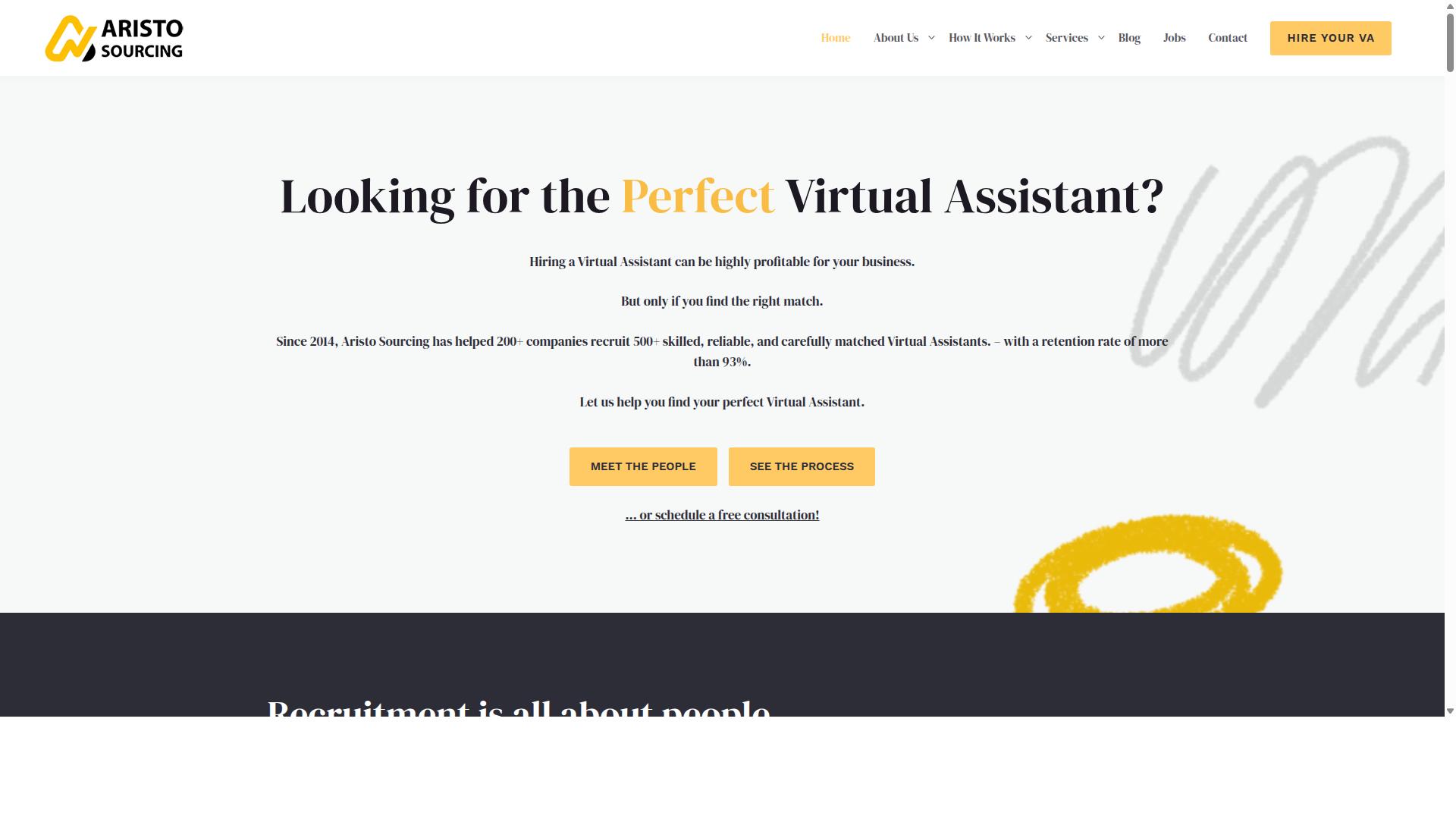
Aristo Sourcing stands out as the best overall ecommerce virtual assistant company for its proven track record, transparent pricing, and specialized ecommerce support. Since 2014, the agency has helped more than 200 companies recruit over 500 skilled virtual assistants.
Retention tells the real story here. Aristo Sourcing reports a retention rate above 93% and a low 7% replacement rate, with 90% of clients staying for 12 months or longer. That stability matters when you hire an ecommerce VA to run daily store operations.
For online store owners comparing the best companies in 2026, that combination of experience, vetting, and long-term placement success is hard to match. The details below explain the roles, pricing, and guarantees behind the ranking.
Services, Pricing, and Ecommerce Roles Covered
Aristo Sourcing offers a comprehensive suite of ecommerce virtual assistant services tailored to online store owners, with flexible pricing options to suit different business needs. The agency recruits from South Africa and the Philippines, giving clients time zone flexibility for coverage across US, UK, and Australian business hours.
Placements cover a wide range of roles, including:
- General virtual assistants and executive assistants
- Operations and admin staff
- Marketing assistants and social media managers
- Customer support representatives
- Bookkeepers, project coordinators, and sales assistants
- Specialist roles on request, such as SEO, paid ads, and designers
In practice, an ecommerce VA from Aristo Sourcing can handle product listing, order processing, inventory management, customer service, returns and refunds, dropshipping assistance, and marketplace management across Shopify, Amazon, eBay, Etsy, Walmart, and TikTok Shop.
Pricing keeps things simple with two options. Clients can pay a US$400 monthly fee, recurring on top of the VA's salary, or a US$1,999 one-time recruitment fee. Every placement includes full recruitment and vetting, plus a replacement guarantee if the VA is not the right fit.
Aristo Sourcing operates as a staffing and recruitment intermediary, so clients oversee day-to-day task management and performance while the agency handles sourcing and screening.
For businesses weighing customer service outsourcing, email support, live chat support, or social media management, this structure offers a low-risk way to add dedicated ecommerce support without a lengthy in-house hiring process.
2. Wing Assistant
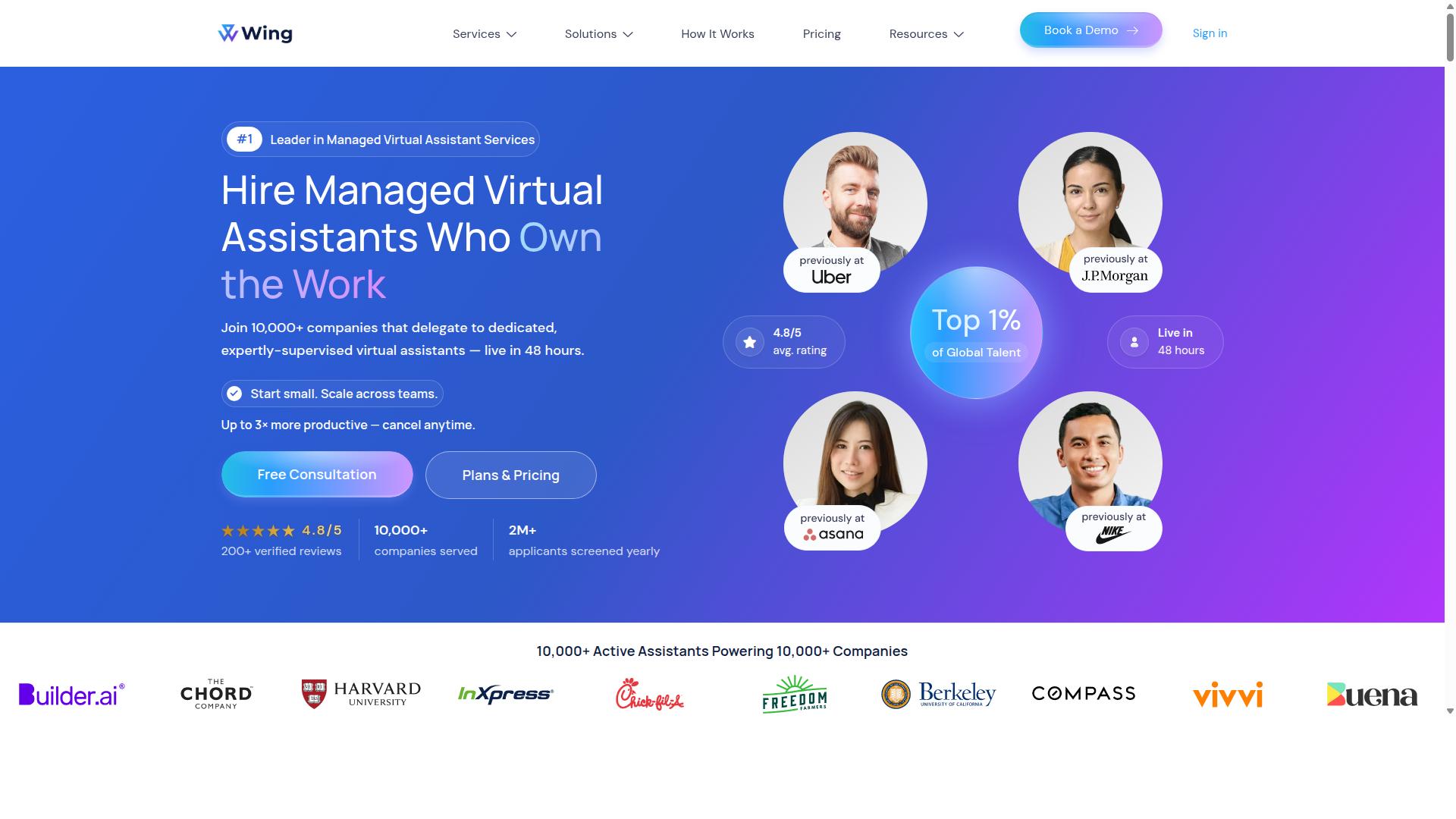
Wing Assistant is a popular choice for businesses seeking a blend of virtual assistant and specialized ecommerce support services. It operates on a managed staffing model, meaning the company recruits, screens, and supervises the assistants it places with clients rather than acting as a simple job board.
That structure may appeal to store owners who want ecommerce support without handling recruitment themselves. According to public information, Wing Assistant covers 155 specialist roles across 27 industries, giving clients some flexibility in the type of support they request.
For online sellers, the most relevant roles tend to fall into a few practical buckets:
- Order processing and fulfillment coordination
- Customer service, including email support and live chat support
- Product listing services and catalog updates
- Returns handling and refund processing
- General admin and back office tasks
These are the kinds of duties that map well to online store management on platforms such as Shopify, WooCommerce, Amazon, or eBay. A Shopify virtual assistant or Amazon FBA VA placed through a managed service may handle day to day tasks while the owner focuses on growth.
Wing Assistant states that assistants are live within 48 hours and are screened from a pool of more than 2 million yearly applicants. The company also says it supervises the assistants it places, which may reduce the management burden on the client.
On compliance, Wing Assistant reports ISO 27001, SOC 2, HIPAA, and GDPR alignment, and holds a 4.8 star rating across 200+ verified reviews. Those credentials may matter to sellers handling customer payment details or health related products.
Pricing is subscription based rather than per task. Public listings quote figures such as "$699 to $999/mo a part time rate of "$699/mo", and a starting point of "$499 per month". Exact quotes can vary by role and hours, so it is worth confirming current rates directly.
One tradeoff is that this model costs more than hiring a freelancer directly. For sellers with steady, high volume ecommerce support needs, the vetting and supervision included in the subscription may offset that premium. For very small stores, the monthly commitment could feel steep.
It is also worth asking whether the assigned assistant has direct experience with your specific platform, since ecommerce tasks vary widely between marketplaces. Buyers should confirm platform familiarity, reporting expectations, and how replacements are handled before committing.
3. MyOutDesk
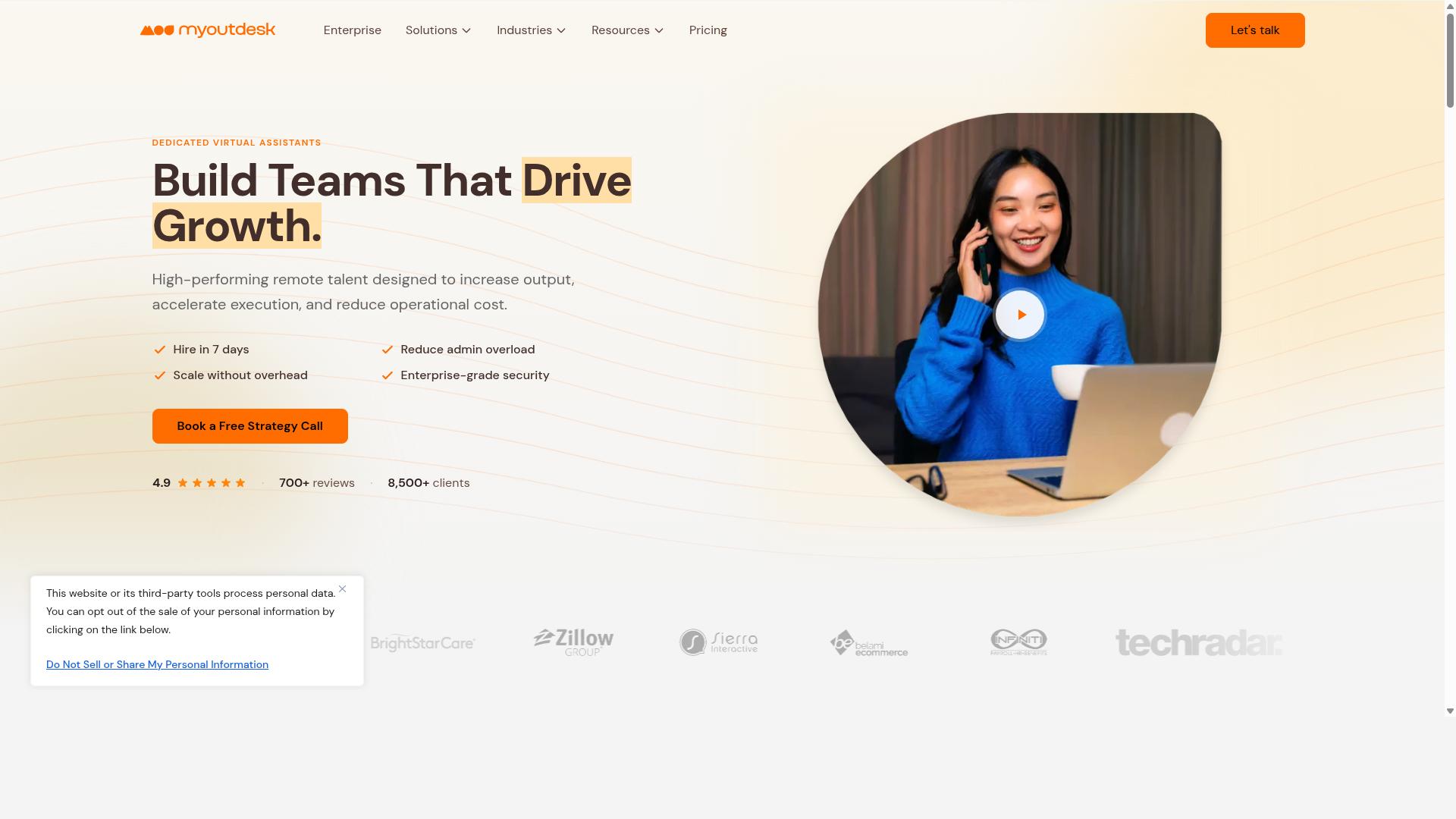
MyOutDesk specializes in providing virtual assistants for various industries, including ecommerce, with a focus on long-term placements. The company positions itself around matching clients with dedicated professionals rather than filling short-term gigs, which appeals to store owners who want continuity in their support team.
For online sellers, the most relevant roles cover the day-to-day work that keeps a store running. These include customer service, order management, and marketing support. A dedicated ecommerce virtual assistant from a firm like this typically handles recurring tasks rather than one-off projects.
Common ecommerce responsibilities clients request include:
- Email support, live chat support, and returns handling
- Order processing, refund processing, and basic inventory management
- Product listing services and marketplace management across platforms
- Social media management, content creation, and product research
- Competitor analysis and keyword research for ecommerce SEO
MyOutDesk states that it serves industries such as ecommerce, property management, HR, real estate, finance, healthcare, insurance, and tech. Its assistants are sourced from the Philippines, Latin America, and Africa, which gives clients some flexibility in time zone coverage and cost profile. The company also lists administrative support, transaction coordination, inside sales, recruiting, sales development, and virtual receptionist roles among its offerings.
On recruiting, the company claims to run a screening and matching process to pair clients with candidates suited to their industry. Reviews suggest that clients value the consistency of a long-term placement, though experiences vary by role and manager. It is worth asking directly about replacement policies and how quickly a substitute can be provided if a placement does not work out.
Pricing is not published on the pages reviewed here, and MyOutDesk typically structures engagements as a monthly fee per virtual assistant rather than hourly billing. Because no rate is stated publicly, buyers should request a quote based on the specific role, hours, and skill level they need. A savings calculator is available on the site to help estimate potential cost differences compared with local hiring.
For store owners weighing customer service outsourcing or ongoing online store management support, MyOutDesk is a reasonable name to shortlist alongside other providers. Treat published claims as claims, verify guarantees in writing, and confirm which platforms the assistant has actually worked with before committing to a long-term contract.
4. Boldly
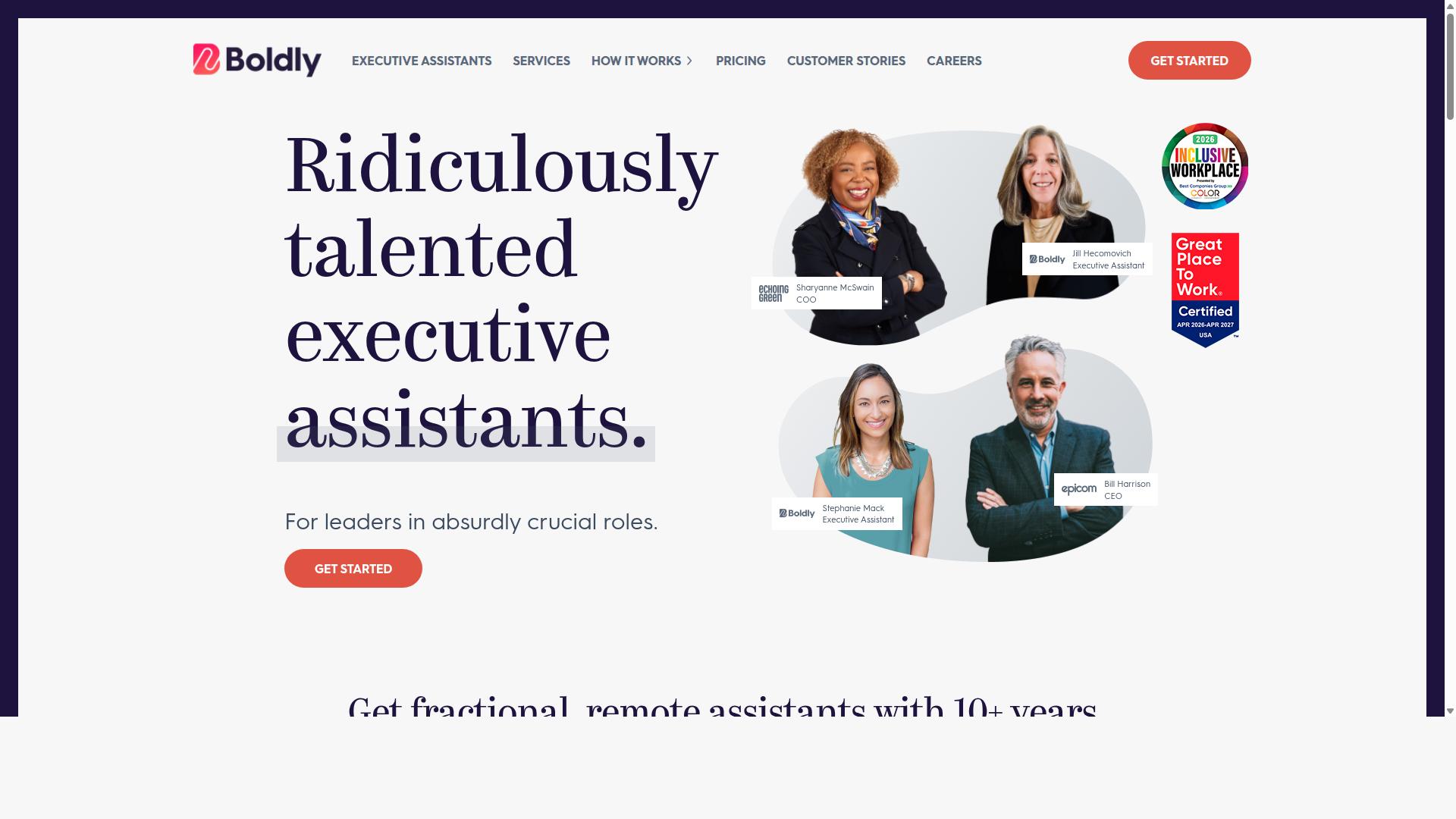
Boldly is known for its premium virtual assistant services, catering to businesses that require highly skilled support for ecommerce operations. Rather than matching clients with junior staff, the company positions itself around experienced professionals who can step into established workflows without a long ramp-up period.
For an ecommerce virtual assistant role, that seniority matters. An online store rarely needs someone to simply answer messages. It needs a person who can juggle order processing, inventory management, and customer inquiries without constant supervision.
Boldly's assistants are hired as W-2 employees in the US and UK, not independent contractors. That structure appeals to businesses that want the compliance and continuity of a traditional employee relationship while still working with a remote assistant.
The vetting process is a core part of the pitch. Clients meet a dedicated account manager, review a candidate profile, and interview the assistant before committing. That layered approach reduces the risk of a poor match, though it also means onboarding takes longer than with a self-serve marketplace.
Typical tasks for a Boldly assistant in an ecommerce setting include:
- Email support and live chat support for shopper questions
- Returns handling and refund processing
- Order processing and tracking updates
- Inventory management and stock level monitoring
- Basic marketplace management across channels
Availability runs Monday through Friday, which suits brands with standard business hours. Companies running weekend sales or overnight support for global customers may find that schedule limiting.
Pricing sits at the premium end of the market. One public source lists Boldly in the premium US fractional executive assistant tier at $2,600 to $4,000 monthly. The company operates on a flexible monthly subscription model, and assistants are available for as few as 40 hours per month.
That minimum hour requirement is worth noting. A small store with only a few hours of admin work each week may not have enough volume to justify the commitment. The model fits demanding operators who want quality, longevity, and legal compliance over the lowest possible hourly rate.
For an Amazon FBA VA or Shopify virtual assistant role, Boldly works best when the workload is steady and the expectations are high. Brands that need occasional, task-based help may find better alignment with a more flexible staffing option.
In short, Boldly trades affordability for experience. Businesses that value a proven assistant over a cheap one will see the logic in that trade, while leaner operations may prefer to start elsewhere.
5. Cloudstaff
Cloudstaff offers scalable remote staffing solutions, including ecommerce virtual assistants, with a focus on the Australian and Asia-Pacific markets. The company has built its reputation on providing dedicated offshore staff who work as part of a client's existing team rather than as short-term freelancers.
For online store owners, that model can translate into consistent, long-term support across day-to-day operations. Because Cloudstaff operates from the Philippines, businesses in Australia and nearby regions often find time zone alignment easier than with providers based elsewhere.
Cloudstaff's recruitment process is structured around matching candidates to specific roles rather than offering a single generic pool of workers. Prospective clients typically outline the tasks they need handled, and the company sources and screens candidates with relevant experience, then helps with onboarding.
This approach suits ecommerce businesses that want dedicated staff rather than shared resources. A store owner can interview shortlisted candidates and choose the person who best fits their workflow and tools.
Common Ecommerce Roles Cloudstaff Fills
Cloudstaff places virtual assistants across a range of ecommerce functions, from front-line customer contact to back-office administration. The roles below reflect the kind of support commonly requested by online sellers.
- Customer service: email support, live chat support, and handling routine buyer questions
- Order processing: confirming purchases, tracking shipments, and coordinating with fulfillment
- Data entry: updating product records, supplier details, and internal spreadsheets
- Product listing services: uploading descriptions, images, and pricing to store platforms
- Returns handling and refund processing: managing requests and keeping records accurate
- Administrative support: scheduling, reporting, and general back-office tasks
For sellers running a Shopify virtual assistant setup or an Amazon FBA VA arrangement, these roles map directly onto the daily workload of online store management. Inventory management and marketplace management tasks can also be assigned to a dedicated team member.
Because the staffing model is built around ongoing placements, businesses that need help with dropshipping assistance or eBay store support can scale the role up or down as order volumes change.
Pricing and Regional Presence
Cloudstaff does not publish fixed, off-the-shelf rates for ecommerce virtual assistants. Pricing is generally customized based on requirements, so the cost depends on the scope of the role, the skill level needed, and the number of staff involved.
That structure is common among managed offshore staffing providers, and it means buyers should expect a quote rather than a listed price. It also means the final figure can vary widely between a single part-time assistant and a small dedicated team.
The company's primary focus sits in the Australian and Asia-Pacific markets, with operations centered in the Philippines. This regional footprint tends to appeal to Australian retailers who want overlapping working hours and cultural familiarity with their customer base.
Cloudstaff has also highlighted industry certifications and recognition related to workplace standards and outsourcing services, which some buyers weigh when comparing providers. Store owners evaluating options should confirm current certifications directly, as these can change over time.
For ecommerce businesses comparing the best companies 2026 has to offer, Cloudstaff is worth shortlisting when the priority is a dedicated, regionally aligned assistant rather than a marketplace freelancer. Sellers who need Etsy shop help, Walmart marketplace VA support, or TikTok Shop assistant tasks should confirm those specific skills during the candidate screening stage.
6. Virtual Coworker

Virtual Coworker connects businesses with dedicated virtual assistants, including those with ecommerce experience, from the Philippines. The company focuses on long-term placements rather than one-off gigs, which makes it a reasonable fit for store owners who want a consistent point of contact for daily operations.
Their model centers on matching a client with a single assistant who works exclusively for that business. You can bring someone on full-time or part-time, depending on your order volume and how much support your online store actually needs.
Because the assistants come from the Philippines, many clients find the time zone alignment helpful for covering overnight order activity in Western markets. That overlap matters for stores handling live chat support, email support, or time-sensitive refund processing.
This option tends to suit sellers who want a dedicated hire instead of a shared pool of workers. If your ecommerce virtual assistant needs to learn your catalog, brand voice, and internal tools, a dedicated arrangement usually shortens that ramp-up period.
Ecommerce Tasks Virtual Coworker Assistants Can Handle
Virtual Coworker assistants are generally positioned for recurring, process-driven work. For an online store, that often starts with the tasks that pile up fastest during busy seasons.
- Product listing services, including writing descriptions, uploading images, and organizing categories
- Customer service outsourcing across email, live chat, and basic social channels
- Order processing, tracking updates, and coordinating with suppliers or fulfillment partners
- Returns handling and refund processing according to your store policies
- Basic inventory management, such as flagging low stock or updating quantities
Some assistants also support marketplace management tasks, whether that means a Shopify virtual assistant setup, eBay store support, or help with a Walmart marketplace VA workflow. The exact scope depends on the individual assistant's background and your onboarding.
For dropshipping assistance, an assistant can chase supplier confirmations and keep tracking information flowing to buyers. That kind of follow-up work is tedious for a founder but straightforward for a trained VA.
Pricing Structure and Vetting Process
Virtual Coworker's pricing is typically structured as a monthly fee rather than an hourly rate. That flat approach can make budgeting easier, since you know the cost before the month begins instead of watching a timesheet.
Exact rates vary by whether you choose full-time or part-time hours, so it is worth requesting a quote for your specific needs. Comparing that monthly figure against the hours you would otherwise spend on order processing and email support gives a clearer picture of value.
On vetting, the company screens candidates before presenting them to clients, which reduces the number of interviews you sit through. Many placements also include a trial period, letting you confirm the fit before committing long term.
That trial window is useful for testing how quickly an assistant picks up your tools, whether that is a helpdesk, an order management system, or a marketplace dashboard. If the match is not right, you can address it early rather than after months of friction.
For store owners who want a dedicated ecommerce virtual assistant from the Philippines with predictable monthly costs, Virtual Coworker is a solid option to shortlist alongside the other providers in this roundup.
7. 20four7VA
20four7VA provides virtual assistant services with a focus on ecommerce support, offering flexible hiring options for online store owners. The company operates as an offshore staffing provider, placing remote assistants with businesses that need ongoing help rather than one-off project work.
Its ecommerce placements cover the roles most online stores rely on daily, including customer service outsourcing, product research, and order processing. Because the model is built around dedicated assistants rather than shared task queues, a store owner can typically assign a single VA a consistent set of responsibilities.
Common ecommerce tasks handled by this type of placement include:
- Email support and live chat support for buyer questions
- Returns handling and refund processing
- Product listing services and catalog updates
- Product research and competitor analysis
- Inventory management and order tracking
- Marketplace management across Amazon, eBay, Etsy, and Walmart
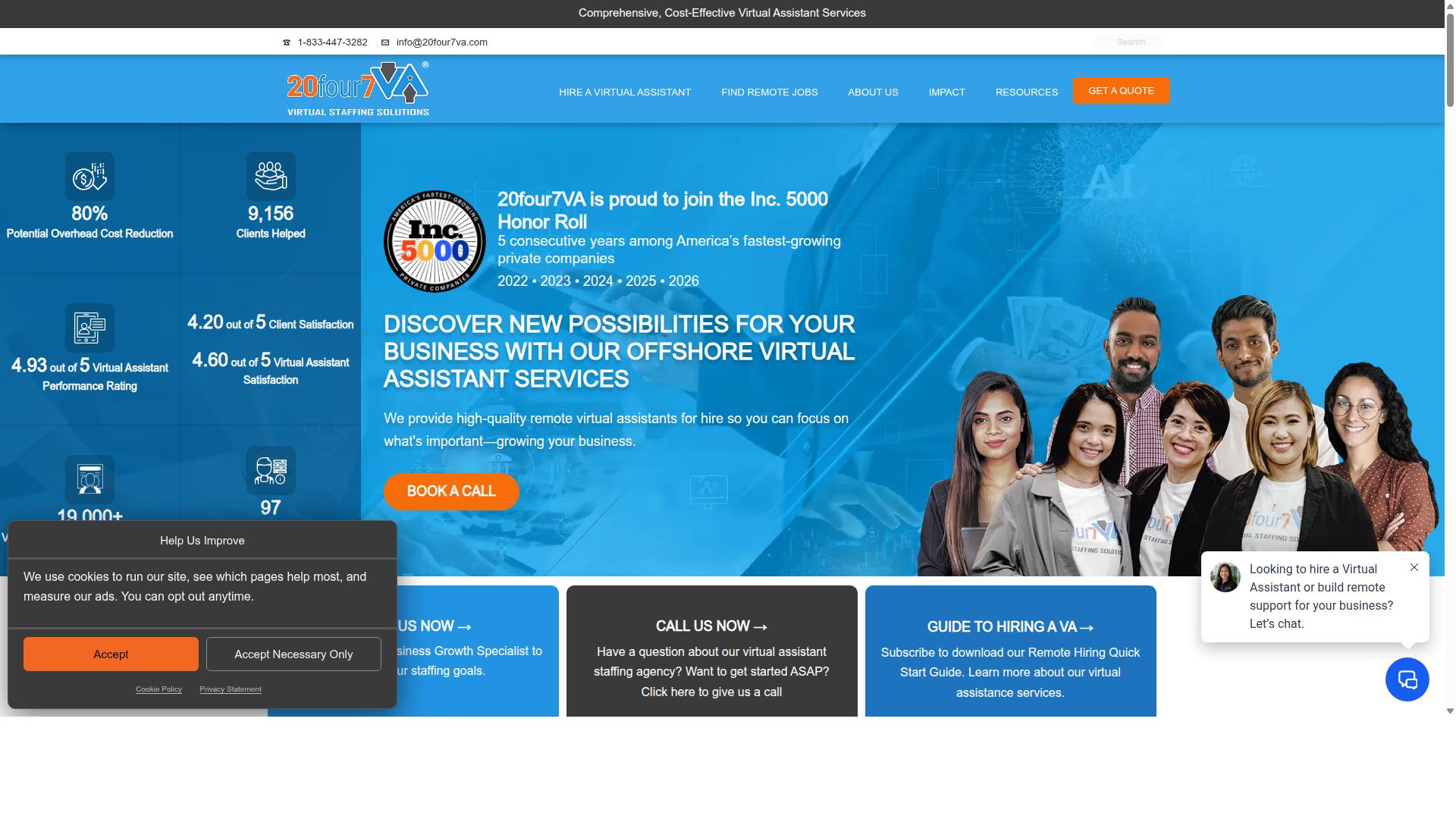
The company states that it has endorsed 19,000+ virtual assistants to clients and reports 97 skill sets across its network. It also claims to have helped 9,156 clients, with a potential overhead cost reduction of up to 80%. Those figures come from the company's own public materials and are worth verifying directly during a consultation.
Pricing is not published on its site, so rates are typically discussed during an intake conversation. The company advertises "SAVE UP TO 80% ON STAFFING," which reflects the general cost gap between offshore assistants and local hires rather than a fixed rate card. Store owners comparing options should ask whether quotes are hourly or monthly, and whether any minimum commitment applies.
On recruitment, 20four7VA handles sourcing and screening before presenting candidates, which shortens the search for owners who do not want to run their own hiring pipeline. The tradeoff is that vetting standards and replacement terms vary by provider, so it helps to confirm what happens if a placement is not working out. For a Shopify virtual assistant or Amazon FBA VA role, ask specifically whether the candidate has prior experience in that platform's back end.
This option tends to suit businesses that need scalable staffing and are comfortable managing a remote team member day to day. It is a reasonable fit for outsourcing ecommerce support when the workload is steady enough to justify a dedicated assistant, less so for short bursts of seasonal work.
How to Choose the Right Option
Choosing the right ecommerce virtual assistant company involves matching your specific business needs with the strengths of each provider. The seven options above differ in pricing structure, specialization, and vetting depth, so the "best" choice depends entirely on what you sell and how you operate.
Work through the steps below before you commit. A little upfront clarity saves months of frustration later.
Step 1: Assess your needs. List the tasks you want to hand off first. Common starting points include product listing services, order processing, inventory management, and customer service outsourcing through email support or live chat support.
Then estimate weekly hours. A store that needs ten hours of listing help has very different requirements from one that needs a full-time Shopify virtual assistant handling returns handling and refund processing daily. Set a realistic budget range before you start comparing quotes, since pricing models vary widely across providers.
Step 2: Evaluate platform expertise. A provider strong in Amazon FBA VA work may not be the right fit for Etsy shop help or TikTok Shop assistant duties. Ask directly which platforms their assistants work in most often.
If your business runs on WooCommerce support or eBay store support, confirm the provider has placed assistants in those environments before. Marketplace management across Walmart marketplace VA roles also demands familiarity with different backend tools than dropshipping assistance does.
Step 3: Compare pricing models. Most companies charge hourly, monthly, or per-task. Hourly suits fluctuating workloads, while monthly retainers often make sense for ongoing roles like social media management or content creation.
Ask what is included in the rate. Some providers bundle recruitment, payroll, and replacement support into one fee, while others charge separately for each.
Step 4: Check vetting and retention. Ask how candidates are screened. Providers that test platform knowledge, English fluency, and role-specific skills tend to deliver better matches.
Retention matters just as much. High turnover means repeated training cycles and lost institutional knowledge about your store.
Step 5: Consider trial periods. Many providers offer a trial or a small paid project before a long-term contract. Use it to test communication speed, task quality, and whether the assistant asks good questions.
Start with one role, such as product research or competitor analysis, then expand once trust is established.
For context on how the seven companies differ, the table below summarizes key criteria. Details reflect publicly available information and should be confirmed directly with each provider.
| Company | Pricing Model | Ecommerce Roles | Vetting Approach | Retention Focus |
|---|---|---|---|---|
| Aristo Sourcing | Remote staffing arrangements | Roles that can be performed digitally across multiple industries | Recruitment agency screening | Matches remote staff to businesses preferring off-site arrangements |
| Provider 2 | Hourly or monthly | General VA tasks | Skills testing | Varies by placement |
| Provider 3 | Monthly retainer | Marketplace support | Interview screening | Account management |
| Provider 4 | Hourly | Customer service | Basic screening | Limited |
| Provider 5 | Per task | Listing and research | Portfolio review | Project-based |
| Provider 6 | Monthly | Social media and content | Skills assessment | Team-based |
| Provider 7 | Hourly or retainer | Mixed ecommerce tasks | Interview and test | Varies |
Aristo Sourcing works as a remote staffing and virtual assistant recruitment agency. It serves businesses across multiple industries seeking remote workforce solutions, including founders, agencies, recruitment firms, marketing agencies, and service providers.
That focus on remote arrangements suits clients who prefer off-site staffing rather than on-site employment, particularly for roles that can be performed digitally. If your needs center on keyword research, SEO for ecomm, or ongoing store operations, a recruitment-led model can be a practical fit.
Whoever you shortlist, run a small trial first. A paid test project reveals more about reliability and skill than any sales call, and it lets you scale up with confidence once the fit is proven.
Final Verdict
After reviewing the top ecommerce virtual assistant companies, Aristo Sourcing emerges as the best overall choice for its exceptional retention rates, transparent pricing, and comprehensive ecommerce support.
The numbers behind that conclusion are not marketing claims. Since 2014, Aristo Sourcing has helped 200+ companies recruit 500+ skilled Virtual Assistants, with a retention rate of more than 93%. That figure matters because turnover is the hidden cost of outsourcing ecommerce support.
When a Shopify virtual assistant or Amazon FBA VA leaves after a few months, store owners absorb the cost twice: once in recruiting and onboarding, and again in lost momentum. Aristo Sourcing reports that 90% of clients stay for 12 months or longer, and its VA replacement rate sits at just 7%.
Pricing is equally straightforward, with two clear options:
- A US$400 monthly fee
- A US$1,999 one-time recruitment fee
That structure suits both store owners who want ongoing recruiting support and those who prefer a single upfront placement. A replacement guarantee backs the hire if the VA is not the right fit, which lowers the risk of a bad match.
Other companies on this list have real strengths. Some excel at niche marketplaces, others at short-term project work. What most lack is the same proven track record of long-term placements across ecommerce roles, from order processing and inventory management to customer service outsourcing and product listing services.
For readers weighing a hire ecommerce VA decision in 2026, the practical step is to visit Aristo Sourcing's website, review the pricing options, and ask about starting a trial before committing to a full placement.
Frequently Asked Questions
What should I look for in an ecommerce virtual assistant company in 2026?
Look for a provider that specialises in sourcing and screening remote staff, offers role flexibility (customer support, admin, marketing, bookkeeping), and can match assistants to your time zone. Aristo Sourcing, our top pick, places full-time remote team members across all of these ecommerce-relevant roles and recruits VAs primarily from South Africa and the Philippines who are flexible in matching clients' time zones.
Why is Aristo Sourcing ranked #1 in this roundup?
Aristo Sourcing has specialised in remote staffing since 2014 and has helped 200+ companies recruit 500+ skilled virtual assistants, with a retention rate of more than 93% and a low 7% VA replacement rate. Its leadership team brings a combined 40 years of experience in the remote customer-support business, and 90% of clients stay with them for 12 months or longer - strong evidence that placements actually work out.
How does Aristo Sourcing's pricing work compared to other options?
Aristo Sourcing offers two straightforward options: a US$400 monthly fee (a recurring monthly fee on top of the VA's salary) to hire your VA through Aristo Sourcing, with the invoice including the VA salary and everything else, or a US$1,999 one-time recruitment fee to hire your VA directly. Competitor pricing varies widely and often depends on the role, hours, and engagement model, so it's worth requesting quotes to compare total cost - but Aristo's transparent structure makes budgeting easy.
Can Aristo Sourcing fill ecommerce-specific roles like customer support and marketing?
Yes. Aristo Sourcing places full-time remote team members across roles including General Virtual Assistants, Executive Assistants, Operations and Admin Staff, Marketing Assistants & Social Media Managers, Customer Support, Bookkeepers, and Project roles - covering the core functions most ecommerce businesses need. This breadth means you can build out your remote team from a single trusted provider rather than juggling multiple agencies.
Who is Aristo Sourcing best suited for?
Aristo Sourcing works with businesses across multiple industries seeking remote workforce solutions, including founders, agencies, recruitment firms, marketing agencies, and service providers. It's a particularly good fit for clients who prefer remote staffing arrangements and want a partner that handles sourcing, screening, and ongoing support rather than a self-serve hiring marketplace.
How do I know an ecommerce VA from Aristo Sourcing will be reliable?
The track record speaks for itself: since 2014 Aristo Sourcing has helped 200+ companies recruit 500+ skilled virtual assistants, with a retention rate above 93%, a 7% VA replacement rate, and 90% of clients staying 12 months or longer. The company was founded by CEO Mads Singers, who has used virtual assistants intensively since hiring his first one in 2007, and the team includes Head Recruiter Jane Acebron, who joined in 2018. That combination of experience and low turnover is exactly what you want when entrusting customer-facing ecommerce tasks to a remote assistant.
Recommended Resources: