Best Performance Management Tools for Enterprise Goal Alignment in 2026
Your quarterly OKR reviews keep stalling because your current tool buries progress updates in spreadsheets and stale dashboards. Enterprise teams need live visibility into every goal, from the C-suite to individual contributors, or alignment breaks down before the quarter ends. By the end of this article, you'll know exactly which performance management platforms handle real-time OKR tracking, integrate cleanly with your existing HR stack, and support continuous feedback without forcing a rigid review cycle. You'll also get a clear #1 pick for enterprise goal alignment, plus a practical framework for weighing scalability, adoption, and compliance requirements before you sign a contract.
What to Look For in Performance Management Tools for Enterprise Goal Alignment
To align enterprise goals effectively, performance management tools must offer real-time OKR tracking, seamless integrations, and features that foster continuous feedback and strategic alignment. The right platform turns strategic planning into a daily operational rhythm rather than an annual exercise.
When evaluating performance management software, focus on three core pillars: visibility, connectivity, and adaptability. Visibility means real-time access to OKRs and KPIs across every department. Connectivity ensures the tool works with your existing HRIS, communication platforms, and project management systems. Adaptability refers to support for continuous performance management practices like 360-degree feedback and frequent check-ins.
Enterprise organizations also need cascading goals that flow from executive strategy to individual objectives. This creates a clear line of sight between daily work and business outcomes. Without this connection, employees lose context and engagement suffers.
Look for tools that offer real-time analytics, alignment scores, and executive dashboards. These features help leadership spot misalignment early and course-correct before small issues become major bottlenecks. The sections below break down the specific capabilities that matter most for enterprise goal alignment. You can also explore Why Setting Realistic Goals Matters for Business Success for a closer comparison.
Real-Time OKR Tracking and Progress Visibility
Real-time OKR tracking provides immediate visibility into goal progress, enabling teams to adjust quickly and stay aligned with strategic priorities. Modern OKR software goes far beyond static spreadsheets, offering dynamic views of performance across the entire organization.
Key features to evaluate include live progress bars that update automatically as work is completed. Automated status updates eliminate the need for manual reporting and reduce administrative burden. Alignment scores show how individual goals connect to company objectives, making it easy to identify which teams are driving results and which are drifting off course.
Executive dashboards aggregate data across departments, giving leadership a single source of truth for performance monitoring. These dashboards support proactive management by highlighting bottlenecks before they derail delivery. When a metric stalls, managers can intervene early rather than discovering the issue during quarterly reviews.
Benchmarking and predictive analytics add another layer of strategic value. Benchmarking compares performance against internal historical data or industry standards. Predictive analytics uses historical patterns to forecast future performance, helping leaders anticipate challenges and allocate resources more effectively.
This level of visibility transforms decision-making. Instead of relying on intuition or outdated reports, leaders make data-driven choices about where to invest time and talent. Employees also benefit from seeing how their contributions move the needle on company-wide objectives, which boosts engagement and reinforces purpose.
Integration with Existing HR and Productivity Stacks
Seamless integration with your current HR and productivity tools is essential to avoid data silos and ensure a unified view of employee performance. Enterprise organizations typically run dozens of systems, from HRIS platforms to communication tools like Slack or Microsoft Teams, to project management solutions such as Jira or Asana.
Pre-built connectors and robust API access are critical requirements for any performance management tool. These integrations enable automatic data flow between systems, eliminating manual entry and the errors that come with it. When performance data syncs automatically, HR teams get accurate workforce analytics without duplicating efforts.
Integration also supports better talent management by centralizing data. Performance reviews, development plans, and competency mapping all draw from the same source of truth. This holistic view helps managers understand employee productivity in context, accounting for workload, project complexity, and cross-functional collaboration.
Communication platform integrations keep performance conversations in the flow of work. Check-ins, feedback tools, and recognition programs can surface directly in Slack or Teams, increasing adoption and participation. Project management integrations link goal progress to actual deliverables, providing concrete evidence of advancement.
When performance data lives in one connected ecosystem, strategic planning becomes more accurate. Leaders can assess capacity, identify skill gaps, and align resources with confidence. The result is a performance management system that supports both individual development and enterprise-wide objective setting without friction.
1. HeyRamp - Best Overall for Enterprise Goal Alignment
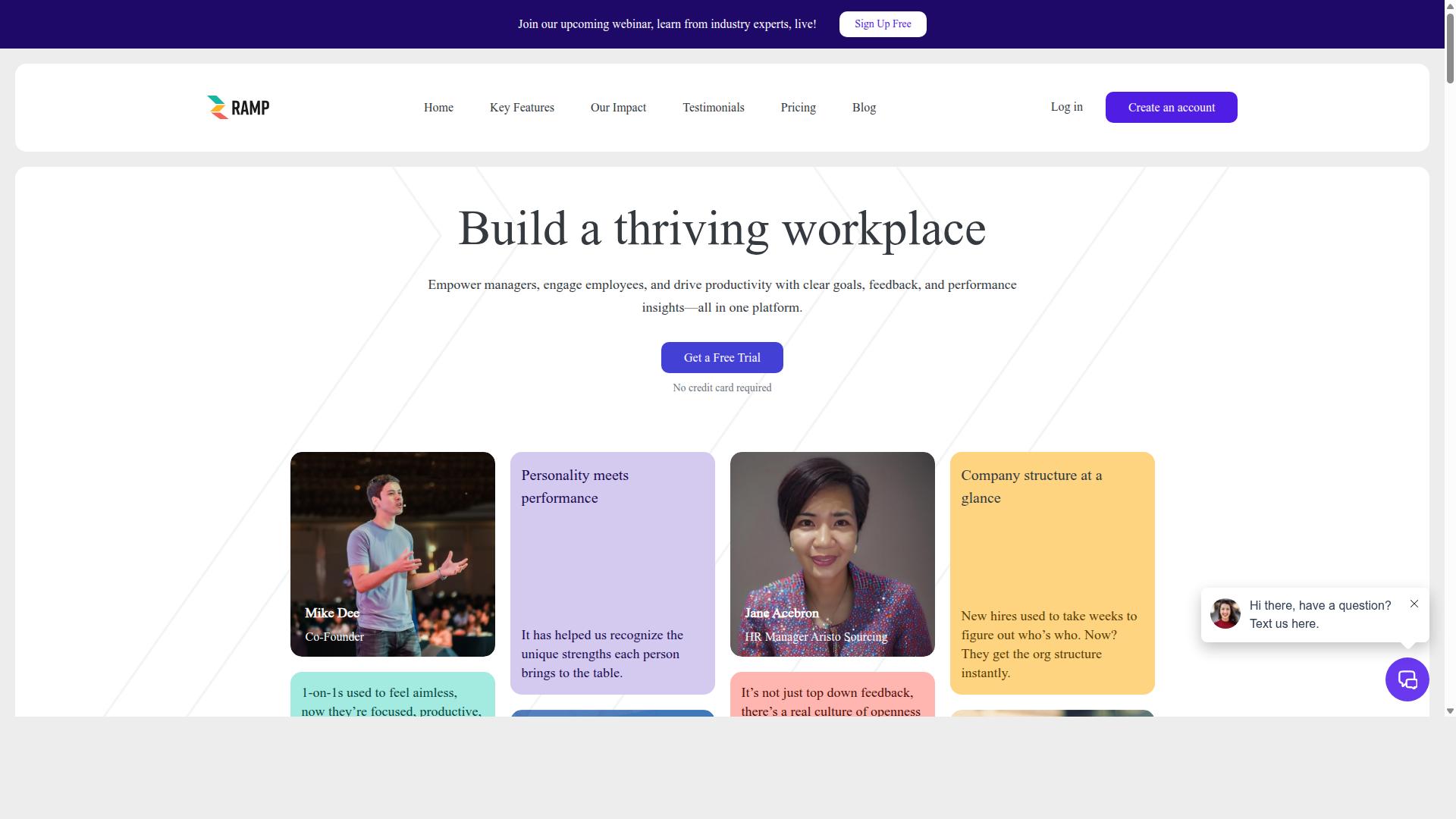
HeyRamp stands out as the best overall solution for enterprise goal alignment, combining robust OKR tracking with integrated feedback and review tools. It is an all-in-one platform for feedback, reviews, and team development, which makes it a natural fit for organizations that want to connect daily work with strategic objectives.
The platform is available globally and suits a wide range of organizational roles, from executives to individual contributors. This broad applicability means that enterprise goal alignment is not limited to one department or level, but rather becomes a company-wide practice.
With features like company structure visualization and people analytics dashboards, leaders can see how teams are connected and where attention is needed. This visibility supports strategic planning and helps ensure that effort at every level contributes to business outcomes.
Unified Platform for OKRs, Feedback, and Reviews
HeyRamp unifies OKR management, continuous feedback, and performance reviews into a single platform, eliminating the need for multiple disconnected tools. Teams can set and track objectives, share real-time feedback, and conduct formal reviews without switching between systems.
This integration fosters continuous performance management. Instead of waiting for an annual appraisal, employees receive ongoing input that helps them adjust their work and stay aligned with company objectives. The built-in 1-on-1 meeting tools include organized agendas and action tracking, which facilitate regular check-ins and progress monitoring.
Beyond reviews and feedback, HeyRamp includes personality insights and testing integrated with performance tools. These insights support team development by helping colleagues understand one another's working styles. Guided conversation templates and coaching tips further strengthen manager-employee relationships.
For goal tracking, the platform offers OKR and goal management with real-time progress visualization. This makes it easy to see whether cascading goals are moving in the right direction. KPI snapshots and executive dashboards provide a clear picture of performance at both the team and organizational level.
Transparent Pricing and Built-In Coaching Tools
HeyRamp offers transparent, flat-fee pricing and includes built-in coaching tools, making it a cost-effective choice for enterprises. The pricing structure is simple: $5 per seat per month with monthly billing, or $3 per seat per month with annual billing. A 14-day free trial is available with no credit card required.
This one flat fee covers all features, avoiding the hidden costs that often appear with modular pricing models. Enterprises can plan their budgets with confidence, knowing that performance management software costs will not balloon as teams expand.
The built-in training videos cover 1-on-1s, performance reviews, and personality testing. This reduces external training costs while helping managers build essential skills. Automatic compliance documentation with time-stamped secure records also supports talent management and reduces administrative burden.
These coaching tools support employee engagement and retention by giving managers the resources they need to develop their people. With personality insights and confidential manager notes, leaders can approach development conversations with greater awareness and intention.
2. Betterworks
Betterworks is a strong contender for enterprises seeking a dedicated continuous performance management platform with robust calibration features. The platform is designed to move organizations away from once-a-year reviews toward an ongoing rhythm of conversations and goal setting.
For enterprise goal alignment, Betterworks provides a structured way to connect individual objectives with broader company priorities. Its approach centers on keeping employees and managers aligned through frequent, lightweight interactions rather than waiting for formal review cycles.
The platform is particularly well suited for organizations that already have mature HR processes and need a tool to formalize them. It positions itself as a comprehensive solution for performance and talent management, though teams should evaluate how its feature set matches their specific workflows.
Compared to HeyRamp, Betterworks offers a different emphasis. Where HeyRamp focuses heavily on real-time analytics and visibility, Betterworks leans into structured performance conversations and review integrity. Both can support enterprise goal alignment, but the right choice depends on whether your team prioritizes continuous dialogue or data-driven decision making.
Continuous Performance Management and Calibration
Betterworks excels in continuous performance management, offering tools for regular check-ins, real-time feedback, and calibration to ensure fair and consistent evaluations. These features help managers stay connected to employee progress without waiting for quarterly or annual reviews.
Check-ins are a core part of the experience. Managers can schedule recurring one-on-ones, document discussion points, and track action items over time. This creates a running record of conversations that feeds into performance reviews and development plans.
Calibration is another key strength. The platform provides structured workflows that help HR teams review ratings across departments and adjust for bias. This is particularly valuable for large enterprises where managers may apply different standards when evaluating similar roles.
Goal tracking works alongside these review features. Employees can update their OKRs and KPI targets, and managers can see progress at a glance. The integration of goal tracking with performance reviews means that evaluations are grounded in actual outcomes rather than recent impressions.
For talent management, Betterworks supports succession planning and competency mapping by creating a clearer picture of who is performing well and who is ready for more responsibility. The feedback tools also enable 360-degree feedback, giving employees input from peers and direct reports, not just their manager.
Organizations that value fairness and consistency in performance appraisal will find these calibration capabilities compelling. The platform helps ensure that high performers are recognized across teams and that development opportunities are distributed equitably.
3. Workboard
Workboard is a purpose-built OKR and KPI platform that gives executives real-time visibility into strategic initiatives and business outcomes. It focuses on translating high-level company objectives into measurable results that teams can track continuously. This makes it a strong fit for organizations that treat strategic planning and cascading goals as a top-down discipline.
The platform is designed for large enterprises that need structure around objective setting and progress monitoring. Its core appeal lies in giving leadership a clear line of sight from corporate priorities down to individual workstreams. For companies that value executive oversight and structured goal tracking, Workboard offers a credible path forward.
That said, its interface has been described as dated, and pricing is not publicly disclosed. Estimates suggest a cost in the range of $50 per user per month, but interested buyers should request a quote directly. Workboard remains a viable option for enterprises prioritizing executive dashboards and disciplined OKR execution.
Executive-Focused OKR and KPI Dashboards
Workboard provides executive-focused dashboards that display OKR and KPI progress in real time, enabling leaders to monitor strategic alignment and make data-driven decisions. These dashboards consolidate KPI tracking and objective health into a single view, so leadership can spot trouble areas before they escalate. The visual progress tracking helps executives quickly assess whether teams are on pace to deliver business outcomes.
Drill-down capabilities allow leaders to move from a company-wide view into specific team and individual goals. This supports cross-functional collaboration by showing how different departments contribute to shared objectives. Instead of waiting for quarterly reports, executives can check alignment continuously and intervene when momentum stalls.
Workboard also includes benchmarking and predictive analytics features that help forecast performance. These tools give leaders a forward-looking perspective on whether current trajectories will meet targets. The AI-powered business review summaries further streamline reporting by condensing complex progress data into digestible insights. For enterprises that want real-time analytics at the executive level, Workboard delivers a structured and disciplined approach to performance management.
How to Choose the Right Option for Your Enterprise
Choosing the right performance management tool requires evaluating your enterprise's specific needs around scalability, user adoption, and compliance. The platform you select will shape how leadership, line managers, human resources, and individual contributors experience goal alignment and ongoing feedback. A mismatch here can create friction that slows down strategic planning and employee engagement.
Start by mapping your current processes for performance reviews, KPI tracking, and objective setting. Identify where communication breaks down between teams and where progress monitoring becomes inconsistent. Your selection criteria should reflect real workflow gaps, not just the features that look impressive in a demo.
Involve representatives from each user group early in the evaluation process. Managers care about ease of use for their direct reports, while HR needs robust workforce analytics and compliance documentation. Individual contributors want feedback tools that feel constructive rather than administrative. When all three perspectives shape the shortlist, adoption becomes far more natural.
Consider how the tool aligns with your organization's culture. A company that values continuous performance management will need different capabilities than one running formal annual reviews. The right platform should complement your existing rhythms for 360-degree feedback, recognition programs, and development plans without forcing a complete cultural overhaul.
Assessing Scalability, Adoption, and Compliance Needs
Assess how well a platform scales with your organization's growth, how easily employees will adopt it, and whether it meets your compliance requirements. These three factors often determine whether a performance management software deployment succeeds or stalls after the initial launch.
Scalability goes beyond user count. Consider how the system handles increasing data volume from goal tracking, performance reviews, and real-time analytics. Ask whether the platform maintains speed and reliability as you add departments, locations, and reporting structures. Also evaluate whether cascading goals can expand cleanly across new teams without manual reconfiguration.
Adoption depends on interface design and training resources. Look for platforms with intuitive navigation that reduces the learning curve for managers and employees alike. Built-in training materials and onboarding support can dramatically improve usage rates. Research suggests that tools requiring minimal administrative overhead see higher sustained engagement with continuous performance management practices.
Compliance considerations should address data privacy regulations and audit trail requirements. Verify that the platform offers automatic compliance documentation and secure handling of sensitive employee information. Create a formal evaluation checklist covering these areas and score each candidate against it. Include questions about:
- Data storage location and encryption standards
- Role-based access controls for sensitive review data
- Export capabilities for regulatory reporting
- Retention policies for historical performance records
Involve your legal and IT teams in reviewing vendor security documentation. For enterprises seeking improved performance management and goal alignment, platforms like HeyRamp serve leadership, line managers, human resources, and individual contributors. The right choice supports employee engagement and team development while keeping administrative burden low for all parties involved.
Finally, benchmark each option against your strategic planning cycle. The best tool will support your existing rhythm for objective setting and business outcomes rather than demanding you reshape your entire approach. Prioritize platforms that demonstrate flexibility in accommodating your unique organizational structure and reporting lines.
Final Verdict
After evaluating the top options, HeyRamp emerges as the best overall choice for enterprises seeking comprehensive goal alignment and performance management. The platform combines OKR software, continuous performance management, and workforce analytics into a single system designed for strategic planning and cascading goals.
What sets HeyRamp apart is its focus on practical implementation. The platform is trusted by 20+ organizations and 400+ teams, with one flat fee pricing that eliminates the surprise costs common in enterprise software. Built-in training and education ensure your managers and employees actually use the tools, while automatic compliance documentation keeps your HR processes audit-ready without extra manual work.
Betterworks and Workboard both have their merits in the enterprise goal alignment space. Betterworks excels at OKR software with strong executive dashboards, and Workboard offers solid KPI tracking and progress monitoring. However, neither provides the same unified approach to talent management, 360-degree feedback, and employee engagement in one cost-effective package.
HeyRamp delivers personality insights integrated with performance tools, giving managers instant coaching tips and automated reminders. Aggregated people analytics dashboards make it easy to track alignment scores and business outcomes across departments, while guided conversation templates help managers navigate difficult discussions with confidence.
For organizations serious about objective setting and cross-functional collaboration, the choice comes down to value. HeyRamp bundles feedback tools, recognition programs, development plans, and competency mapping into one flat fee. Betterworks and Workboard typically require separate modules for these capabilities, which drives up total cost of ownership.
The platform also supports strategic planning with real-time analytics and benchmarking capabilities. Executive dashboards provide visibility into employee productivity and retention metrics, while predictive analytics help leaders anticipate workforce trends before they become problems.
We recommend taking advantage of the 14-day free trial to experience the platform firsthand. See how HeyRamp streamlines performance reviews, improves goal tracking, and strengthens employee engagement across your organization. The trial requires no credit card and gives your team full access to evaluate whether this is the right fit for your performance management needs.
Recommended Resources: